Returning a loved one to their ancestral home in Italy is a profound act of remembrance, but the technicalities of international borders often feel like an insurmountable barrier. You are likely asking, can you mail cremains to italy whilst ensuring they are treated with the highest level of respect? It is a question born of a desire for dignity and a valid anxiety regarding bureaucratic delays or the distressing thought of a sacred urn being mishandled by customs officials during transit.
We recognise that the intersection of Italian health regulations and international transport laws can be overwhelming when you are already grieving. This guide offers a professional roadmap to help you navigate these requirements with confidence and peace of mind. You will learn about the specific documentation required for 2026 repatriation, the mandatory packaging standards currently in place, and why a dedicated courier service provides a level of stewardship that standard postal networks cannot guarantee. We provide the clarity you need to ensure your loved one’s final journey is completed safely, legally, and with the professional composure this moment demands.
Key Takeaways
- Understand the complex legal status in 2026; whilst the answer to can you mail cremains to italy is yes, they are governed by strict health regulations that require specific clearances beyond standard parcel rules.
- Identify the essential documents needed for your repatriation “dossier” and why you should allow a minimum of 10 to 15 working days for administrative preparation and consular verification.
- Learn the “siftproof” packaging standards and urn material requirements necessary to meet both international transport laws and specific Italian cemetery regulations for entombment.
- Discover how specialist international ashes repatriation services mitigate the risks of standard postal networks by providing a single point of contact for Italian customs and health department clearance.
- Gain a clear, step-by-step roadmap for a secure, door-to-door journey that ensures your loved one arrives safely and with the professional dignity this sensitive task requires.
Can You Mail Cremains to Italy? Legal Status and 2026 Regulations
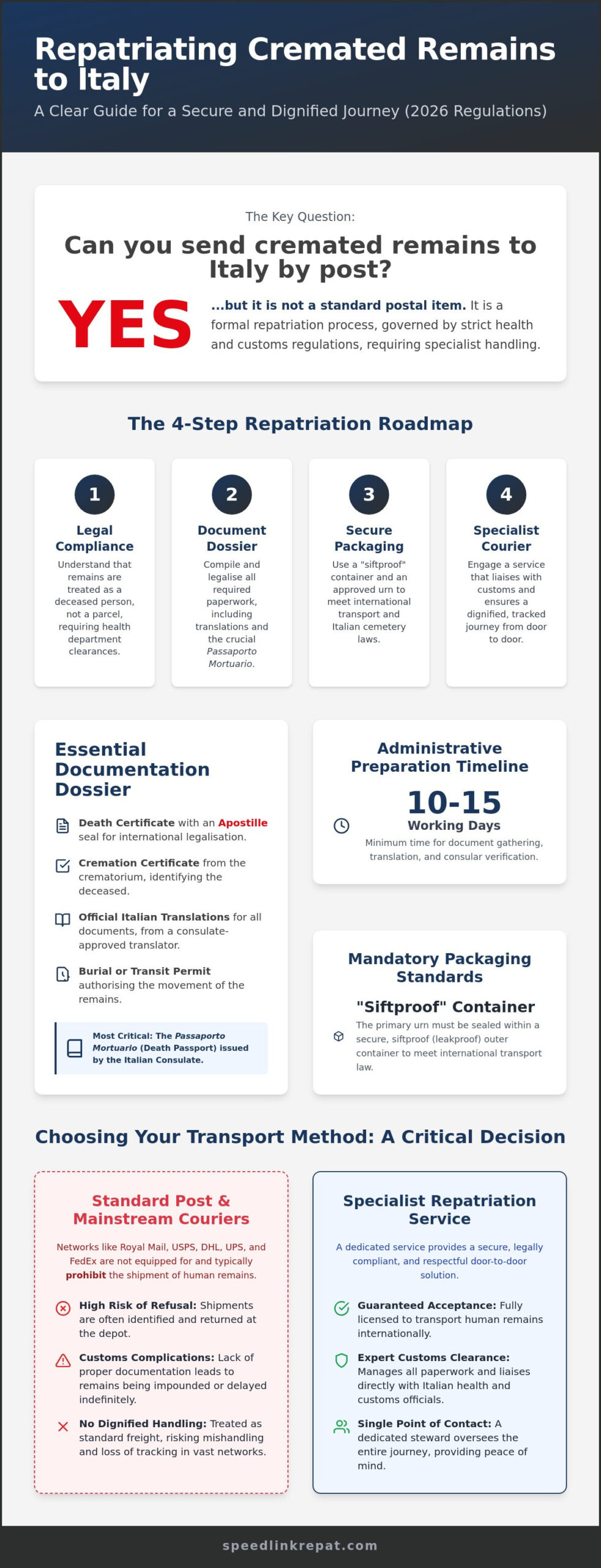
The technical answer to can you mail cremains to italy is yes, but the reality is a sophisticated logistical operation rather than a simple trip to the post office. In the eyes of Italian law, cremated remains are treated with the same legal weight as a deceased body. This classification means that every shipment is subject to strict health department clearances and must follow formal Repatriation protocols to ensure the journey is both legal and dignified.
As we move through 2026, regulations have become increasingly stringent. Italian customs now mandate advanced digital declarations before the ashes even leave their country of origin. There is also a heightened focus on “siftproof” packaging standards to prevent any possibility of leakage during transit. Failing to meet these specific criteria doesn’t just result in a delay; it can lead to the remains being impounded or returned at the border. Understanding the distinction between “mailing” via a standard postal service and “repatriation” via a specialist courier is the first step in avoiding these distressing outcomes.
The Role of the Italian Consulate
Before any transport begins, you must liaise with the Italian Consulate in your departing country. They act as the primary regulatory body for the transfer. The most critical document they provide is the Passaporto Mortuario, or Death Passport. This document is an essential requirement for international transit, confirming that all health and safety standards have been met. Without this consular seal, the remains cannot legally enter Italian territory. Whether you are organising transport from the USA to Italy, Canada to Italy, or Australia to Italy, this consular coordination remains the cornerstone of the process.
International Carrier Restrictions
It is a common misconception that mainstream couriers like DHL, UPS, or FedEx will handle human remains. In reality, most of these providers refuse cremains amongst their standard freight due to the complex legal liabilities involved. Using a standard postal service is equally risky; these networks aren’t designed for the sensitive nature of bereavement logistics. They often lack the tracked, secure, and dignified handling required for such a precious cargo. Relying on a specialist courier ensures that the remains are never treated as mere “merchandise” but as a person returning home under the care of a dedicated steward.
For those who are also managing the broader logistics of an international move or transporting household effects during this transition, you can learn more about Asiatic International Relocation for professional support with global moving services.
Essential Documentation for Sending Ashes to Italy
To successfully pass through Italian customs, every shipment must be accompanied by a comprehensive “dossier” of legal paperwork. This is not a process that can be rushed. We recommend allowing at least 10 to 15 working days for document preparation, as several stages involve third-party government agencies. Central to this process is the “Apostille” certification. This is an international seal that legalises your local documents, ensuring they are recognised as authentic by Italian authorities. Without this specific validation, your paperwork holds no legal weight once it crosses the border.
For a detailed overview of these legal mandates, the Consulate General of Italy provides a list of Essential Documentation for Sending Ashes to Italy which serves as the foundation for a successful transfer. Whilst you might research can you mail cremains to italy and find conflicting advice, following these official consular channels is the only way to prevent your loved one’s remains from being held in administrative limbo.
The Mandatory Document Checklist
- Certified Copy of the Death Certificate: This must bear an Apostille from the relevant issuing authority in your country.
- Cremation Certificate: An official statement from the crematorium confirming the remains are 100% human ashes and identifying the deceased.
- Italian Translation: Every document in the dossier must be translated into Italian by a consulate-approved translator to ensure absolute accuracy for local health officials.
- Burial or Transit Permit: The official authorisation allowing the remains to be moved from the place of death.
The Consular Tag and Death Passport
The final stage of documentation involves the Passaporto Mortuario, or Death Passport. This is an official permit issued by the Italian Consulate that authorises the entry of the remains into Italy. Once approved, the consulate often provides a “Consular Tag” or lead seal. This physical marker must be securely affixed to the outer packaging or the urn itself, depending on specific regional requirements. It serves as a visible signal to customs officers that the contents have been pre-cleared and meet all national health standards. If the administrative burden feels overwhelming during this difficult time, you may wish to speak with our repatriation specialists who can manage the entire dossier on your behalf.
Packaging and Logistics: Ensuring a Dignified Journey
Shipping ashes involves more than just a sturdy box; it requires a commitment to physical and emotional integrity. The “siftproof” standard is a non-negotiable requirement for all international flights. This means the inner container must be hermetically sealed to prevent any leakage under pressure changes in a cargo hold. When investigating Can You Mail Cremains to Italy?, it’s vital to recognise that whilst the postal service allows the transit, their standard handling may not meet the emotional weight of the task. Outer packaging should be discreet to maintain privacy, yet it must carry the required consular labels and the Passaporto Mortuario clearly to avoid unnecessary inspections.
The choice of urn is also a practical consideration for the final destination. Italian cemeteries often have strict material requirements for entombment within a niche or columbarium. Urns must typically be made of durable materials like bronze, marble, or high-grade stone to ensure longevity. If you intend to use a biodegradable urn, this is usually only permitted for specific woodland burials. Checking with the local Italian commune beforehand is essential to ensure the vessel is accepted for the planned service.
Standard Post vs. Specialist Courier
Standard postal networks carry a small but devastating risk of remains becoming “lost in the system.” For irreplaceable remains, this is a risk few families are willing to take. Specialist couriers provide dedicated secure transit lanes and often use hand-carry protocols where the remains stay under the constant supervision of a trained professional. This eliminates the rough handling associated with automated sorting centres. Real-time tracking offers immense emotional relief, providing confirmation of exactly where your loved one is at every stage of their journey to Italy.
When coordinating the transport of such sensitive and irreplaceable cargo, ICAT Detroit provides specialised logistics for high-value and time-critical freight, ensuring that every international shipment is handled with the precision and care required for a secure journey.
Customs Clearance in Italy
The Italian customs office, known as the Dogana, is rigorous in its inspections of sensitive cargo. Standard parcels are often subject to intrusive X-ray scanning, which can be distressing for the family. Specialist repatriation services use specific protocols to clear customs swiftly, often using pre-arranged brokers who understand Italian bereavement law. This ensures the remains are processed with dignity and without the weeks of delay that can occur with standard freight. To ensure your loved one’s journey is handled with this level of precision, you can contact our repatriation team for professional guidance. Additionally, for legal experts who manage these complex international systems and are seeking new career heights, HIA Legal provides specialist headhunting services in major legal hubs.
Specialist Repatriation Services to Italy with SpeedLink Repatriation
Whilst it’s technically possible to navigate the question of can you mail cremains to italy on your own, the layers of bureaucracy and the emotional weight of the task often make professional assistance a necessity. SpeedLink Repatriation provides a compassionate, door-to-door solution designed to take the burden of logistics off your shoulders. We specialise in complex international routes, including dedicated services from the USA to Italy and Australia to Italy. Our role is to act as your ethical guardian, ensuring that every legal requirement is met whilst treating the remains with the profound respect they deserve.
We handle the heavy lifting of international bureaucracy, from coordinating with the Italian Consulate to managing the final customs clearance at the border. We don’t view our cargo as a parcel, but as a person returning to their homeland. This stewardship-first philosophy means we’re constantly monitoring the journey, providing you with a single point of contact who understands the nuances of Italian bereavement law and health regulations.
Our Italy Repatriation Process
- Initial Consultation: We begin by understanding your specific needs, the location of the remains, and the final destination in Italy, whether it’s a family plot in Sicily or a columbarium in Rome.
- Professional Packaging: Our team ensures the urn is prepared to meet both airline safety standards and the specific siftproof requirements of the Italian health department.
- Secure Transit: We avoid standard postal networks, instead using secure, tracked transit lanes that deliver directly to the receiving funeral home or cemetery.
Why Families Trust SpeedLink Repatriation
With decades of experience in bereavement logistics, we’ve built a reputation for reliability and factual accuracy. We understand that this isn’t just a transaction; it’s a final act of love. Our “people-first” approach prioritises your peace of mind, offering a steady hand to guide you through a stressful period. We’ve refined our processes since 2003 to ensure that every detail, from the Apostille to the lead seal, is handled with precision. SpeedLink Repatriation provides the most reliable way to honour a loved one’s final wish, ensuring they return home with the dignity and care they deserve.
Returning Your Loved One Home with Confidence
Navigating the return of a loved one to Italy is a deeply personal task that demands both technical precision and emotional care. You’ve seen that whilst the answer to can you mail cremains to italy is a conditional yes, success depends on a meticulous “dossier” of Apostille-certified documents and the issuance of a formal Death Passport. Relying on standard postal networks in 2026 presents unnecessary risks to irreplaceable remains. Choosing a path of professional stewardship ensures that every health regulation and customs mandate is met with absolute integrity.
Our team of specialist bereavement logistics experts is here to take the administrative burden off your shoulders. We provide comprehensive customs and documentation support alongside secure, door-to-door global delivery to ensure your loved one arrives safely at their final resting place. You don’t have to navigate this complex bureaucracy alone during such a difficult time. Request a Dignified Repatriation Quote for Italy and let us help you honour their final wish with the dignity and professional composure it deserves. To further ease your load during this transition, you can discover Prescott’s Laundry for expert wash and fold solutions that help manage your daily routine.
Frequently Asked Questions
Can I personally take ashes on a plane to Italy instead of mailing them?
Yes, you can carry cremated remains on a flight, but you must still comply with the same legal requirements as international shipping. This includes obtaining the Passaporto Mortuario from the Italian Consulate and ensuring you have a certified death certificate. Most airlines mandate that the urn is X-ray transparent and kept within your carry-on luggage. It’s often a significant administrative and emotional burden to manage these technicalities whilst you are travelling.
How much does it cost to ship cremated remains to Italy in 2026?
The cost of repatriation is determined by several factors, including the country of origin, the weight of the vessel, and current consular fees. You should also account for auxiliary expenses such as Apostille certification and professional Italian translations. Because every journey is a unique logistical task, we recommend requesting a tailored quote to get an accurate understanding of the professional fees and government charges involved for your specific route.
What happens if the ashes are held at Italian customs?
If the Dogana holds a shipment, it’s typically because the documentation dossier is incomplete or the digital customs declaration contains errors. Customs officials will retain the remains in a secure facility until the sender or a professional broker provides the missing paperwork. This is why we act as a single point of contact for customs clearance, ensuring all health department clearances are finalised before the remains ever reach the Italian border.
Do I need a special urn for shipping to Italy?
You must use an urn that is hermetically sealed and “siftproof” to comply with international aviation and Italian health standards. When families ask can you mail cremains to italy, we also advise them to check the material requirements of the final cemetery or commune. Many Italian burial sites only permit entombment in urns made of durable, non-perishable materials like marble, bronze, or high-grade stone.
How long does the entire repatriation process to Italy take?
The entire process generally takes between 15 and 25 working days from the initial consultation to final delivery. The first 10 to 15 days are usually required for administrative preparation, including liaising with the Italian Consulate and securing the necessary Apostilles. Once the documentation is in order, the secure transit and customs clearance typically take an additional 3 to 5 working days, depending on the specific destination in Italy.

Article by
David McMillen
I started my career in logistics over 30 years ago which has spanned 2 continents and several different types of courier and logistics operations. I lost my dear Mum back in 2016 and it was in the aftermath of her passing that SpeedLink Repatriation was born. We have endeavoured to bring the same care and attention to all of our clients as my mum received and to date we have helped repatriate hundreds of individuals across the globe.
Disclaimer
International requirements for cremated remains vary by origin, destination, carrier and method of transport and may change without notice.
Content is provided as general guidance and should not be treated as legal advice.
Where necessary, current requirements should be confirmed with the relevant government authority, customs authority, embassy, consulate, postal operator, airline or carrier.
SpeedLink can advise on the requirements applicable to a specific shipment.