The final journey of a loved one should be defined by dignity and peace, yet for many, it’s often overshadowed by the weight of international bureaucracy. Standing at a customs desk with an urn, only to be told your paperwork is incomplete, is a situation no grieving family should face during their time of loss. We understand that you’re navigating an emotional period, and the fear of a loved one’s remains being delayed or seized due to a technical error only adds to that exhaustion.
It’s entirely natural to feel overwhelmed by conflicting advice from airlines and the complex legalities of crossing borders. This guide provides the clarity you need, offering a definitive 2026 checklist of the documents required for ashes repatriation. We’ll walk you through the ‘Golden Thread’ of essential certificates, explain when you might need an apostille or certified translation, and show you how professional logistics can lift the burden of these legal requirements from your shoulders whilst ensuring your loved one is treated with the utmost respect.
Key Takeaways
- Learn why a standard death certificate is insufficient and why you must secure a certified copy to begin the repatriation process with confidence.
- Understand the role of the Apostille and why official translations are essential for ensuring your paperwork is recognised by international border authorities.
- Discover how to navigate the specific entry permits and documents required for ashes repatriation based on your destination country’s unique legal regulations.
- Find out how partnering with a bereavement logistics specialist can simplify the complex legalisation process and ensure your loved one’s remains are handled with dignity.
The Core Documents Required for Shipping Ashes Overseas
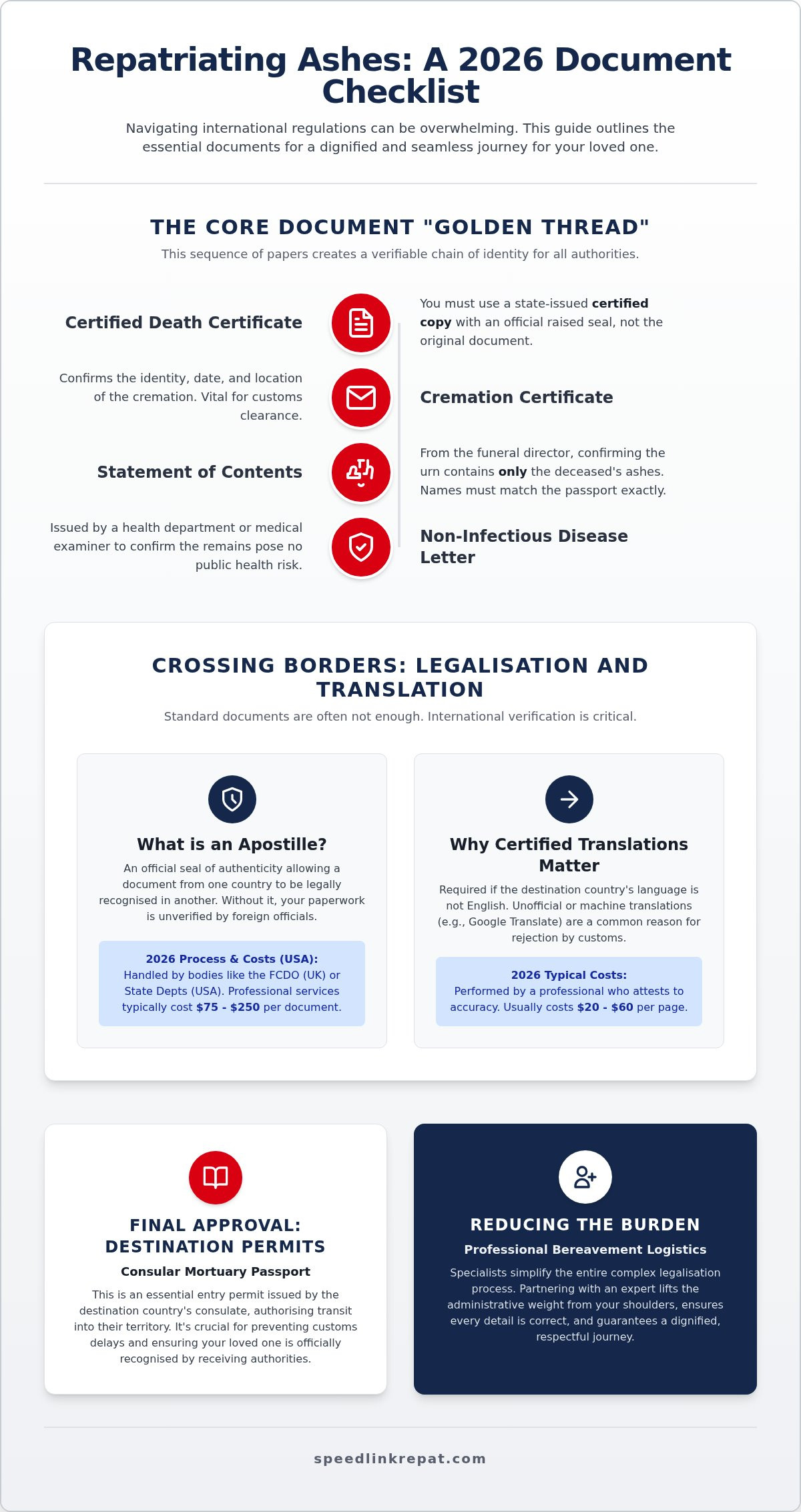
Successfully crossing international borders with cremated remains requires a “Golden Thread” of verification. This sequence of papers ensures that every authority, from airline security to customs officials, can verify the identity and safety of the remains. While international agreements on remains often focus on full-body repatriation, the legal landscape for ashes is distinct. Understanding the documents required for ashes repatriation is the first step in ensuring a dignified journey without bureaucratic interference.
The foundation of your folder is the Certified Copy of the Death Certificate. You shouldn’t use the original document issued at the time of passing; instead, authorities require a state-issued certified copy bearing an official raised seal. Alongside this, the Cremation Certificate is non-negotiable. It confirms the identity of the deceased and provides the exact date and location of the cremation, serving as a vital record for customs clearance. Finally, a Non-Infectious Disease Letter, often issued by a medical examiner or health department, confirms that the remains pose no risk to public health.
The Statement of Contents (Funeral Director Certificate)
A formal letter from the crematorium or funeral director acts as a bridge between the legal paperwork and the physical urn. This document must explicitly state the name of the deceased and confirm that the urn contains only cremated remains. It should also verify that the container is securely sealed for transport. Accuracy is vital here; every detail, especially the spelling of the name, must match the passport of the deceased to avoid delays at security checkpoints.
The Consular Mortuary Passport
Depending on the destination, you may need an entry permit known as a Consular Mortuary Passport. The relevant Consulate issues these papers to authorise the remains for transit into their territory. This is a common requirement when shipping ashes from the USA to the UK or other nations with strict burial laws. Securing these documents required for ashes repatriation prevents the emotional distress of customs delays and ensures your loved one is recognised by the receiving country’s authorities.
Understanding Legalisation: Apostilles and Official Translations
Even with the correct certificates in hand, your folder remains incomplete without legalisation. An Apostille is an official seal of authenticity that allows a document issued in one country to be legally recognised in another. It’s a common stumbling block; many families find that standard UK or USA death certificates are rejected at foreign borders because they lack this international verification. Without this stamp, your paperwork is essentially unverified in the eyes of a foreign official.
The Hague Convention established a simplified system for member nations, but the requirements remain strict. For instance, the CDC requirements for importing remains into the States mandate that all papers are either in English or paired with a verified translation. Ensuring these documents required for ashes repatriation are properly authenticated prevents the heartache of seeing a loved one’s journey stalled by a missing stamp at a critical moment.
How to Organise Document Legalisation
In the UK, you’ll need to submit your papers to the Foreign, Commonwealth & Development Office (FCDO). In the USA, state apostille fees in 2026 generally range between $1 and $25 per document, though professional services that manage the entire process typically cost $75 to $250. These experts ensure your paperwork meets specific 2026 standards, saving you from the stress of administrative rejection during a time of grief.
Certified vs. Standard Translations
If your destination’s official language isn’t English, a standard translation won’t suffice. Customs officials require certified translations, which usually cost between $20 and $60 per page in 2026. These must be performed by a professional who can attest to the accuracy and completeness of the work. Relying on unofficial tools like Google Translate is a risk that often leads to documents being dismissed. If you’re unsure about the documents required for ashes repatriation for a specific country, you can reach out for professional guidance to ensure every detail is handled with care.
Navigating Country-Specific Regulations and Consular Passports
The destination country’s laws ultimately dictate the specific entry permit needed for cremated remains. For instance, when shipping ashes from the USA to the UK, families must navigate a landscape where the lack of a single consular stamp can result in significant delays. It’s vital to declare the urn explicitly as “Human Remains” on all customs forms. This specific classification helps avoid intrusive inspections that might otherwise occur if the item is mislabelled as general freight. Some European consulates also have strict “Maiden Name” requirements. In these cases, the documents required for ashes repatriation must reflect the deceased’s birth name to satisfy local civil registries.
Specific Rules for the USA, UK, and Australia
International transit involves adhering to both national and municipal laws. When arranging Australia to Europe repatriation, you may encounter regional hurdles like the “Starosta” permission in Poland or specific municipal authorisations in Italy. These local permits are often as critical as the national death certificate. Failing to secure these documents required for ashes repatriation at the local level can prevent the final delivery to a cemetery or church.
Airline vs. Courier Documentation
Transporting remains as a passenger is quite different from using a professional courier service. While TSA guidelines on travelling with cremated remains focus on urn materials and security screening, a professional courier operates using an Air Waybill (AWB). This document acts as a legal contract and provides a secure tracking thread. Using a specialist ensures your paperwork is tailored for logistical efficiency rather than just passenger carry-on rules. If these regional variations feel overwhelming, you can request a tailored document checklist from our team to ensure everything is in order.
Reducing the Burden: Professional Assistance with Bereavement Logistics
Managing the “Golden Thread” of documentation whilst grieving is a heavy burden. Many families choose a specialist courier to oversee the documents required for ashes repatriation because the logistical maze is often too complex to navigate alone. A logistics partner doesn’t just transport remains; they act as a central coordinator, liaising with funeral directors globally to ensure every signature is in place. This professional oversight provides a sense of security that carry-on transport cannot match, especially when families are unable to travel themselves.
Beyond the paperwork, professional packaging is essential for international transit. In 2026, airlines and security agencies strictly enforce the requirement for urns to be made of X-ray friendly materials, such as wood, plastic, or cardboard. This ensures the container never needs to be opened during security screening. A dedicated service ensures your loved one’s remains are housed in a compliant outer container that meets these specific international standards. With real-time tracking and door-to-door security, you’re kept informed at every stage of the journey.
How SpeedLink Handles Your Paperwork
Our team provides a steady hand through the intricate maze of international regulations. We adopt a “people-first” approach, recognising that we’re handling a task of deep personal significance. By meticulously reviewing the documents required for ashes repatriation before the journey begins, we prevent the distress of customs delays. We handle the technical mastery of bereavement logistics so you can focus on your farewell, knowing every detail is managed with precision and care.
Next Steps for a Dignified Repatriation
Starting the process begins with a specialised consultation. We’ll help you prepare your initial documents for professional review, identifying any potential gaps in legalisation or translation early on. This proactive approach ensures a smooth transition across borders. If you’re ready to arrange a secure journey for your loved one, our team is here to guide you through each step with the dignity and respect the task demands.
Ensuring a Dignified Final Journey Home
Bringing a loved one home is a journey that deserves absolute precision and care. We’ve explored how the “Golden Thread” of paperwork ensures a smooth transition across borders, from the certified death certificate to the essential cremation papers. You now understand that legalisation through an Apostille and certified translations are often the final pieces needed to satisfy international authorities.
Managing the documents required for ashes repatriation doesn’t have to be a solitary burden. With over 20 years of logistics expertise, our team specialises in secure USA-UK and global routes, offering a dignified door-to-door courier service that prioritises your peace of mind. We take the administrative weight off your shoulders, ensuring every detail is handled with the integrity your loved one deserves.
If you’re ready to begin this final journey, we’re here to help. Please enquire about our international ashes repatriation services today. You’re not alone in this process; our steady hand is here to guide you home.
Frequently Asked Questions
Do I need a death certificate to ship ashes internationally?
Yes, a certified copy of the death certificate is a fundamental requirement for international transport. You shouldn’t use the original document; instead, you’ll need an official copy issued by the state or local registrar bearing a raised seal. This document acts as the primary proof of identity and cause of death, which customs officials and airlines must verify before allowing the remains to cross international borders.
What is an Apostille and is it required for ashes repatriation?
An Apostille is an official certificate that authenticates the signature on a public document, making it legally recognised in other countries. Whether it is required depends on the destination’s specific laws. Many nations participating in the Hague Convention mandate an Apostille on the death certificate as part of the documents required for ashes repatriation. It ensures foreign officials can trust the document’s validity without further embassy verification.
Can I send ashes through standard international couriers like DHL?
No, most standard international couriers like DHL, FedEx, and UPS have strict policies against transporting cremated remains. Using these services often leads to the remains being intercepted or returned. Instead, you should use a specialist service like SpeedLink Repatriation. We provide dedicated door-to-door courier solutions specifically designed for bereavement logistics, ensuring that your loved one is transported securely and in full compliance with international shipping regulations.
What happens if I do not have the correct documents at the border?
Missing paperwork can lead to the remains being seized or refused entry by customs officials. This often results in significant delays and unexpected costs whilst you scramble to secure the missing certificates. In some cases, the remains might be returned to the country of origin at the family’s expense. Ensuring you have all the documents required for ashes repatriation beforehand prevents this emotional distress and ensures a dignified process.
Is a cremation certificate enough to take ashes on a plane?
Whilst a cremation certificate is essential, it’s rarely enough on its own. Most airlines and destination countries also require a certified death certificate and a formal letter from the funeral director or crematorium. This letter should confirm that the urn contains only cremated remains and is securely sealed. You must also ensure the urn is made of X-ray friendly materials to pass through security screening without being opened.

Article by
David McMillen
I started my career in logistics over 30 years ago which has spanned 2 continents and several different types of courier and logistics operations. I lost my dear Mum back in 2016 and it was in the aftermath of her passing that SpeedLink Repatriation was born. We have endeavoured to bring the same care and attention to all of our clients as my mum received and to date we have helped repatriate hundreds of individuals across the globe.
Disclaimer
International requirements for cremated remains vary by origin, destination, carrier and method of transport and may change without notice.
Content is provided as general guidance and should not be treated as legal advice.
Where necessary, current requirements should be confirmed with the relevant government authority, customs authority, embassy, consulate, postal operator, airline or carrier.
SpeedLink can advise on the requirements applicable to a specific shipment.