What if the most difficult part of a final journey isn’t the distance travelled, but the fear that a loved one might be treated as mere freight whilst seeking customs clearance for human ashes? It’s entirely natural to feel distressed by conflicting international laws or the clinical way some authorities handle remains. You need the assurance that this transition will be managed with both professional composure and genuine empathy.
Understanding global regulations and specific documentation is the first step toward a secure repatriation. This article provides a clear checklist of the paperwork needed for a smooth transit whilst highlighting why hand-carry options offer far greater security than standard cargo. By following these essential steps, you can ensure a dignified journey that respects your loved one’s memory and protects them from unnecessary logistical delays.
Key Takeaways
- Learn how to prepare the essential documentation required for customs clearance for human ashes, ensuring every legal requirement is met to avoid distressing delays.
- Understand why selecting an urn made from scan-able materials, such as wood or plastic, is vital to prevent intrusive physical inspections at security checkpoints.
- Recognise the critical distinction between cabin hand-carry and standard air cargo to ensure remains are never placed in the aircraft hold.
- Discover how a specialist repatriation service manages the entire chain of custody, providing you with real-time updates and emotional security.
Navigating Customs Regulations for Cremated Remains
In the context of bereavement logistics, customs clearance for human ashes is the formal process of legal verification. It ensures that the remains and their accompanying paperwork align with the strict entry requirements of the destination country. Unlike standard personal effects or commercial cargo, cremated remains are treated as a unique category of transit. They’re biologically inert and generally exempt from the complex health permits required for full-body repatriation, yet they still require meticulous stewardship at every border.
Regulatory bodies such as the UK Border Force and US Customs and Border Protection (CBP) oversee these arrivals. Their primary focus is to confirm the identity of the deceased and ensure the urn’s contents are exactly as described. Whilst the process is rigorous, it doesn’t have to be clinical. Approaching these authorities with the correct preparation turns a potential obstacle into a respectful formality.
Essential Documentation for International Transit
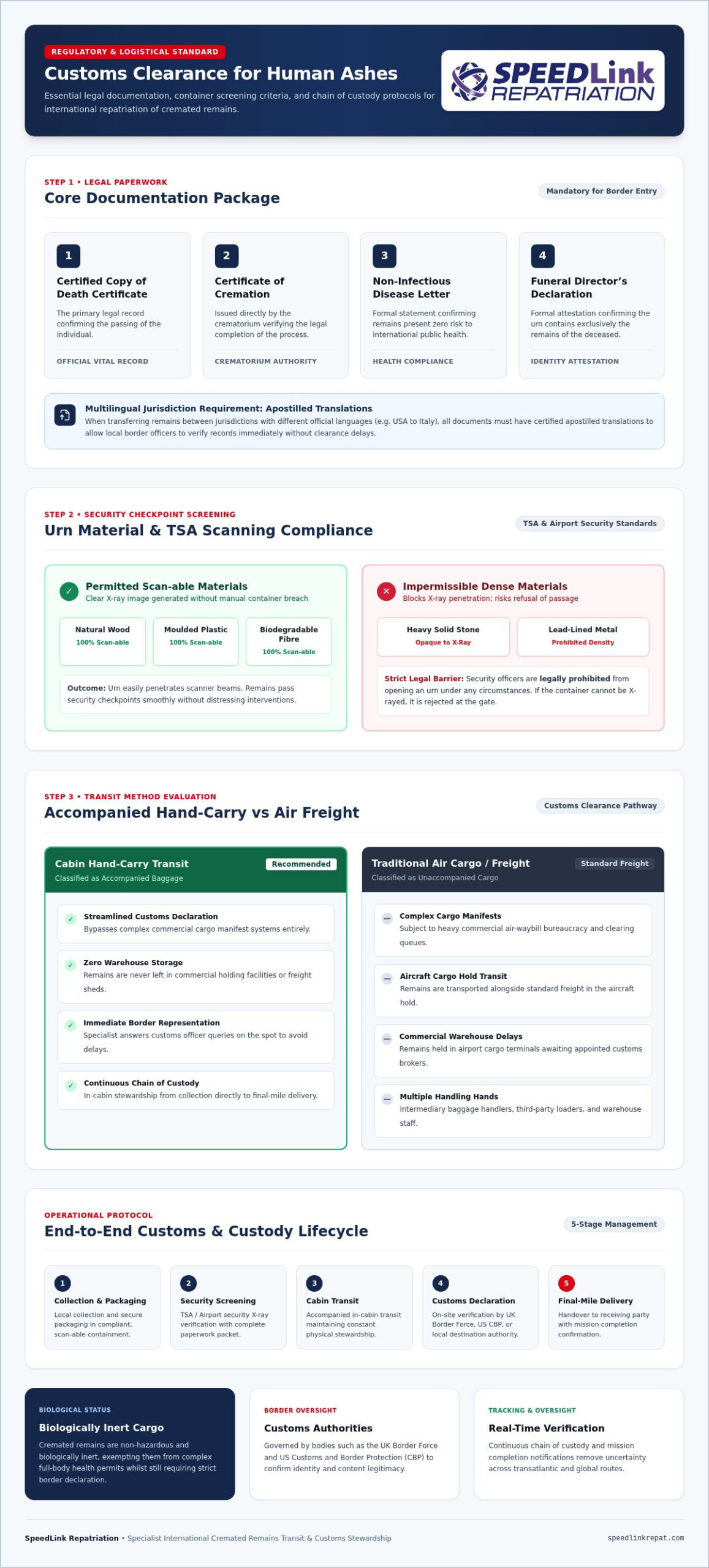
A successful journey depends on a complete paperwork package. You’ll typically need four core documents to secure customs clearance for human ashes:
- Certified Copy of the Death Certificate: The primary legal record of the passing.
- Certificate of Cremation: Issued by the crematorium to confirm the process was completed legally.
- Non-Infectious Disease Letter: A statement confirming there’s no risk to public health.
- Funeral Director’s Declaration: A formal letter stating the urn contains only the remains of the named individual.
If you’re moving between jurisdictions with different official languages, such as moving from the USA to Italy, ensure all documents have apostilled translations. This prevents delays and ensures that local officers can verify information without confusion.
The Customs Clearance Process: A Step-by-Step Overview
The journey begins with local collection and careful packaging. From there, the process moves through airport security and finally to the declaration at the destination border. Having a professional present means any questions from officials are answered immediately, preventing the remains from being set aside or delayed. It is a methodical approach that prioritises both legal compliance and emotional respect.
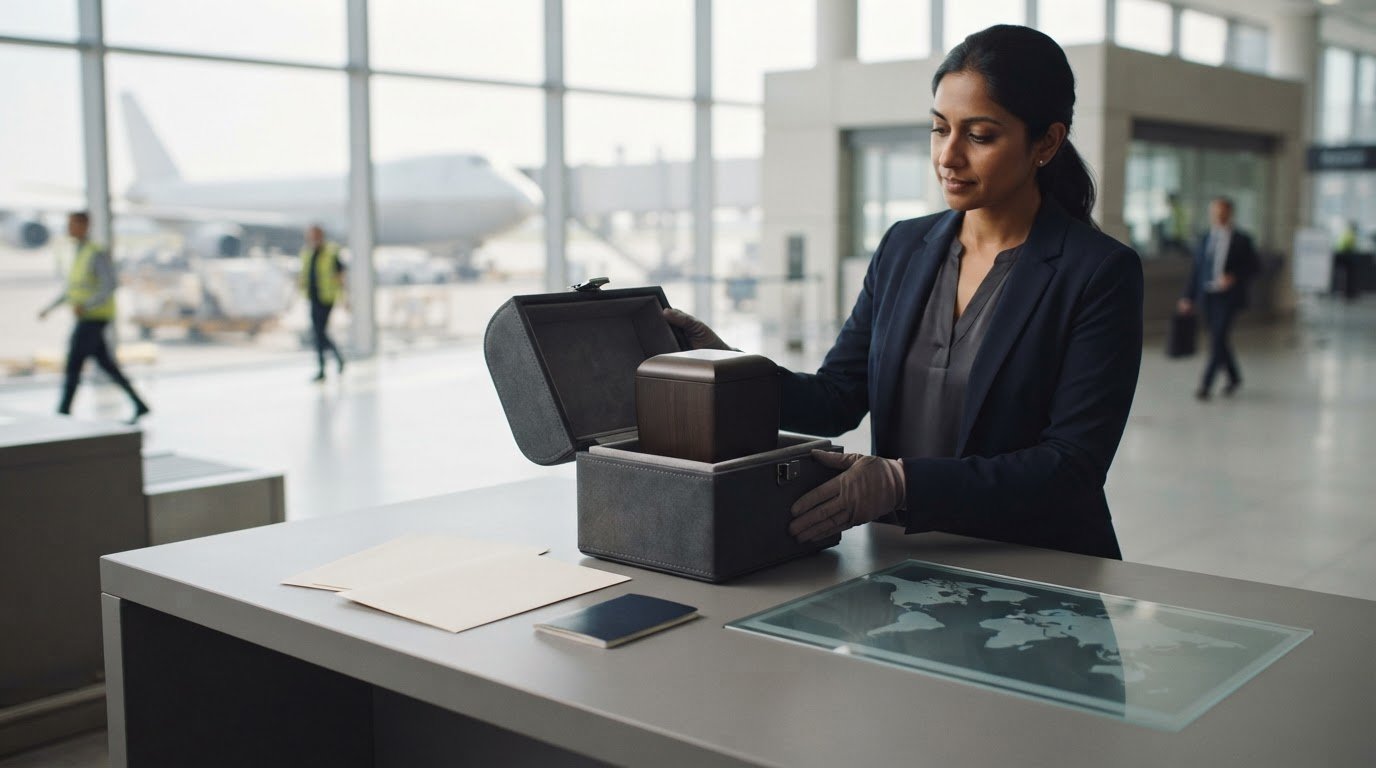
Urn selection is critical. According to TSA guidelines for transporting cremated remains, containers must be made of materials that can be clearly X-rayed, such as wood, plastic, or biodegradable fibre. If a container is too dense, like heavy stone or lead-lined metal, security staff are legally prohibited from opening it. This can lead to a refusal of passage, causing unnecessary distress at the checkpoint.
Hand-Carry vs Air Freight for Customs
There is a significant difference between cabin hand-carry and traditional air freight. SpeedLink Repatriation’s method ensures remains are treated as accompanied baggage. This status often simplifies customs clearance for human ashes, as it bypasses the complex cargo manifest systems used for items in the aircraft hold. It is a faster, more dignified route that avoids the impersonality of a cargo terminal.
Choosing a specialist hand-carry service prevents your loved one from being stored in a commercial warehouse whilst awaiting a customs broker. Our in-house handling maintains a constant chain of custody from start to finish. If you are unsure which regulations apply to your specific destination, you can speak with our repatriation team for tailored guidance and support.
Professional Assistance for Seamless International Repatriation
A repatriation specialist acts as a dedicated steward, managing the entire chain of custody from the moment of collection to the final-mile delivery. Unlike standard logistical providers, these experts prioritise the human element of the journey. Having a central point of contact provides significant emotional relief, offering families a steady hand to guide them through complex procedures. Real-time tracking and mission completion notifications ensure you’re never left wondering about your loved one’s location or status.
Professional services are designed to ensure total compliance with local authority regulations in both the export and import countries. This high level of oversight is what makes customs clearance for human ashes predictable and secure. By verifying every detail before departure, specialists remove the risk of remains being held in clinical cargo facilities or warehouses, maintaining a dignified environment throughout the transit.
Specialist Support for Complex Global Routes
Complex routes require a deep understanding of varying international laws. If you require a USA to UK ashes courier service, the logistics of transatlantic travel must be handled with technical mastery. Similarly, routes from Australia to Europe involve navigating distinct biosecurity rules that can confuse those unfamiliar with the process. To reduce financial anxiety, full-service costs are typically quoted between £400 and £800. This all-inclusive model provides the clarity and control you need, ensuring every administrative and physical detail is managed with professional composure.
Ensuring a Dignified Return Home
Securing customs clearance for human ashes doesn’t have to be a source of anxiety. By preparing the correct documentation and choosing a scan-able urn, you ensure the physical transition is handled with the respect it deserves. Relying on professional stewardship removes the clinical nature of cargo terminals, replacing it with a personal chain of custody that spans the entire globe.
With well over a decade of specialist experience, we provide a dignified hand-carry service where remains stay in the aircraft cabin rather than the hold. Our all-inclusive pricing model, typically ranging from £400 to £800, offers financial clarity, allowing you to focus on what truly matters during this sensitive time. You aren’t alone; a steady hand is ready to manage every logistical detail with empathy and precision.
We’re here to help you bring your loved one home with the care and attention they deserve.
Frequently Asked Questions
Can I take human ashes through customs myself?
You can personally carry remains as accompanied baggage, provided you follow specific airline and international regulations. However, many families find the technical requirements overwhelming during bereavement. Choosing a specialist service ensures that customs clearance for human ashes is managed by an expert who hand-carries the remains in the cabin, protecting the dignity of the journey whilst navigating complex border protocols on your behalf.
What documents are required for international customs clearance of ashes?
You’ll typically need a certified death certificate, a cremation certificate, and a funeral director’s declaration confirming the urn’s contents. Depending on the destination, a non-infectious disease letter or consular clearance may also be required. Having these documents verified by a repatriation specialist before departure is essential to prevent administrative delays and ensure a smooth, respectful transition through international borders.
Will customs officials open the urn during the clearance process?
Officials generally won’t open a cremation container if it’s made from scannable materials like wood, plastic, or biodegradable fibre. In many regions, security staff are actually prohibited from opening an urn, even with permission. Using a vessel that’s transparent to X-ray machines ensures that the verification process remains non-intrusive, upholding the dignity of your loved one throughout the screening and clearance stages.
How long does it typically take for ashes to clear customs?
When remains are hand-carried, customs clearance for human ashes typically occurs within a few hours of arrival. This is much faster than traditional air freight, which often involves remains being held in commercial warehouses for days whilst awaiting cargo manifest processing. A dedicated specialist manages all arrival declarations immediately, ensuring the remains are cleared and delivered to their final destination without any clinical delays.

Article by
David McMillen
I started my career in logistics over 30 years ago which has spanned 2 continents and several different types of courier and logistics operations. I lost my dear Mum back in 2016 and it was in the aftermath of her passing that SpeedLink Repatriation was born. We have endeavoured to bring the same care and attention to all of our clients as my mum received and to date we have helped repatriate hundreds of individuals across the globe.
Disclaimer
International requirements for cremated remains vary by origin, destination, carrier and method of transport and may change without notice.
Content is provided as general guidance and should not be treated as legal advice.
Where necessary, current requirements should be confirmed with the relevant government authority, customs authority, embassy, consulate, postal operator, airline or carrier.
SpeedLink can advise on the requirements applicable to a specific shipment.