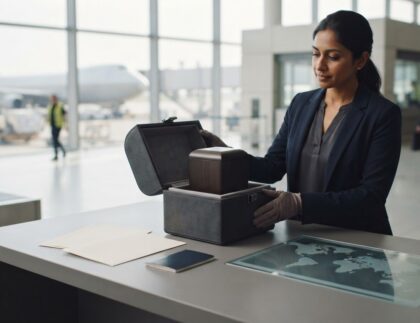
Commercial freight networks were never designed to safeguard irreplaceable human remains across international borders. If you are planning to take a loved one’s urn overseas, the thought of it being mishandled in automated mail hubs or impounded at foreign customs is deeply unsettling. Choosing a dedicated international ashes transport service provides a secure, compassionate alternative, replacing impersonal postal routes with continuous personal supervision and care.
You shouldn’t have to decipher complex consular requirements, translated permits, and strict airline baggage rules alone whilst coping with bereavement. In this guide, you will gain complete clarity on mandatory cross-border paperwork, understand how destination regulations vary, and discover how accompanied cabin transit protects your loved one with unbroken custody from collection to final arrival.
Key Takeaways
- Identify the critical differences between postal restrictions, cargo freight, and accompanied cabin transit to protect irreplaceable cremated remains.
- Review the essential cross-border paperwork required by customs, including certified death certificates, cremation documents, and consular apostilles.
- Discover how a dedicated international ashes transport service maintains continuous personal custody, collecting directly from care providers and hand-carrying urns onto aircraft.
- Prepare for country-specific legal obligations, such as mandatory deliveries to recognised overseas cemeteries, ensuring complete compliance upon arrival.
Understanding International Regulations for Transporting Cremated Remains
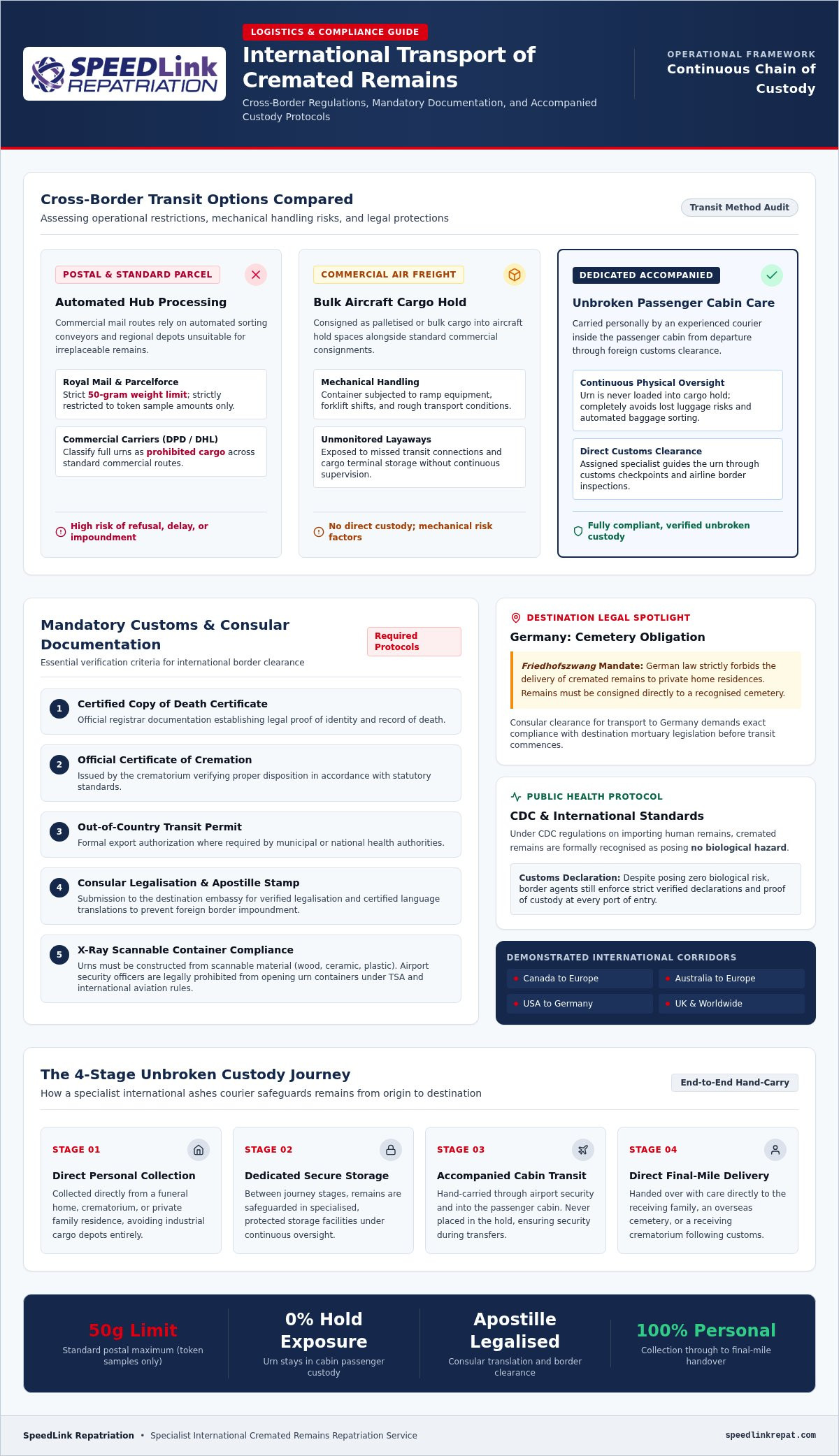
International repatriation of cremated remains involves cross-border transfer governed by complex public health treaties, aviation security mandates, and consular regulations. Many families initially consider standard courier networks or national postal operators, only to find severe obstacles. Royal Mail and Parcelforce, for instance, enforce a strict 50-gram limit, restricting transit to token amounts, whilst private carriers like DPD and DHL classify full urns as prohibited cargo. Transporting a full urn legally overseas requires verifiable documentation, including valid cremation and disposition permits, alongside compliant transport channels.
Because ordinary couriers process parcels through automated sorting machinery, they cannot offer the personal oversight that irreplaceable remains demand. A specialist international ashes transport service bridges this regulatory divide, managing the necessary customs declarations while ensuring the urn is supervised at every stage of the journey.
Key Differences Between Cargo Hold Freight and Accompanied Cabin Transit
Consigning cremated remains to commercial air freight hold spaces places the container amongst bulk cargo, exposing it to mechanical handling, missed connections, and rough transit. By contrast, accompanied cabin transit keeps the urn with an experienced professional inside the aircraft passenger cabin throughout the flight. This dedicated oversight eliminates the risk of lost luggage or unmonitored transfers on long-haul journeys, such as those covered by specialised Canada to Europe courier services. The urn remains protected from departure through customs clearance, ensuring constant dignity and care.
Essential Documentation and Customs Procedures for Overseas Transport
Crossing international borders requires an unblemished chain of documentation. Customs officers require definitive proof of identity, origin, and public health safety. The foundation begins with a certified copy of the death certificate, an official certificate of cremation from the crematorium, and an out-of-country transit permit where applicable.
Many foreign consulates enforce additional legal protocols. Consular transit clearance often mandates certified language translations and legalisation via an apostille stamp. Without these verified seals, border officials can impound an urn until paperwork satisfies local public health laws. Using a dedicated international ashes transport service ensures that every document matches exact consular criteria before departure, avoiding unexpected border delays.
Step-by-Step Paperwork Checklist for International Border Clearance
- Collate certified records: Obtain certified copies of the death certificate and the certificate of cremation.
- Ensure container compliance: Under TSA guidelines for transporting cremated remains and global aviation rules, urns must be scannable by X-ray (such as wood, ceramic, or plastic), as security staff are legally barred from opening containers.
- Verify destination rules: National laws vary widely. For instance, arrange clearance carefully during transport from the USA to Germany, where cemetery obligations (Friedhofszwang) prohibit delivery to private homes and require consigning remains directly to a recognised cemetery.
- Secure consular legalisation: Submit documents to the destination embassy well in advance for apostilles and certified translations.
If you feel unsure about any destination criteria, you can speak with our team for guidance to confirm local customs requirements before travel.
How a Specialist International Ashes Transport Service Operates
A specialist international ashes transport service begins with direct personal custody. Rather than asking families to deliver containers to industrial cargo depots, an experienced team member collects the urn directly from a funeral home, crematorium, or private family residence. Between travel stages, remains rest in dedicated, secure storage facilities. Health protocols are confirmed in advance; while authorities recognise ashes pose no biological hazard under CDC regulations on importing human remains, customs agents still expect strict custody and verified declarations.
The Hand-Carried Transit and Final Delivery Journey
Every flight involves continuous cabin accompaniment. An assigned specialist hand-carries the travel container through airport security and onto the aircraft, never consigning the urn to the aircraft hold. This unbroken chain of custody provides complete reassurance on complex routes, such as when arranging courier assistance from Australia to Europe, where flight transfers and border checks could otherwise create stressful delays.
Upon landing and clearing customs, the courier completes final-mile delivery. The urn is handed over with care directly to the receiving family, an overseas cemetery, or a crematorium according to national regulations. Entrusting this journey to an experienced international ashes transport service removes logistical uncertainty during a difficult time. If you need support with an overseas transfer, please contact SpeedLink Repatriation to discuss your specific requirements.
Taking the Next Step Towards Safe Overseas Repatriation
Arranging cross-border repatriation during bereavement can feel overwhelming, but you don’t have to face complex airline policies and foreign consulates alone. SpeedLink Repatriation brings well over a decade of specialist cremated remains repatriation experience to every journey. Our team provides complete in-house management of customs paperwork, official translations, and border compliance, ensuring every legal requirement is met without delay.
Entrusting this journey to a dedicated international ashes transport service replaces impersonal freight handlers with continuous cabin accompaniment by a dedicated SpeedLink Repatriation team member. Your loved one’s urn remains in compassionate, personal custody from the moment of collection until safe handover at their final destination.
Whenever you are ready, steady guidance and personal support are here to help you bring your loved one safely home.
Frequently Asked Questions
Can you take human ashes on an international flight as cabin luggage?
Yes, most commercial airlines allow cremated remains in the passenger cabin, provided specific airline conditions are met. The urn must be made from X-ray-penetrable materials such as wood or composite plastic, and airlines typically ask for advance notification. Using a specialist international ashes transport service ensures an assigned team member hand-carries the urn throughout the flight, keeping remains in continuous personal custody.
What documents are legally required to transport cremated remains overseas?
Cross-border transport legally requires a certified copy of the death certificate and an official certificate of cremation issued by the crematorium. Depending on the destination country, you may also need a certified crematorium declaration of content, consular transit permits, certified language translations, or apostille legalisation. Verifying requirements with the destination consulate before booking travel avoids unexpected border refusals.
How are cremated remains packaged securely for international travel?
Remains must be secured inside an airtight, sift-proof inner container placed within a protective, non-metallic travel urn. Dense materials like marble, granite, ceramic, and metal block airport security monitors and cannot pass security checkpoints, as officers are legally barred from opening containers. Professional packaging protects the urn within discreet outer luggage that preserves privacy and respects personal dignity.
What happens when cremated remains arrive at foreign customs checkpoints?
Border authorities inspect the accompanying certificates and import declarations to ensure public health compliance. While cremated ashes don’t present sanitary hazards, missing translations or absent consular stamps can lead to distressing border delays. Choosing an international ashes transport service ensures an in-house specialist manages customs clearance directly at the port of entry before completing final-mile delivery.

Article by
David McMillen
I started my career in logistics over 30 years ago which has spanned 2 continents and several different types of courier and logistics operations. I lost my dear Mum back in 2016 and it was in the aftermath of her passing that SpeedLink Repatriation was born. We have endeavoured to bring the same care and attention to all of our clients as my mum received and to date we have helped repatriate hundreds of individuals across the globe.
Disclaimer
International requirements for cremated remains vary by origin, destination, carrier and method of transport and may change without notice.
Content is provided as general guidance and should not be treated as legal advice.
Where necessary, current requirements should be confirmed with the relevant government authority, customs authority, embassy, consulate, postal operator, airline or carrier.
SpeedLink can advise on the requirements applicable to a specific shipment.