
Returning a family member’s remains to their homeland requires absolute precision, leaving no room for administrative confusion or cargo mishandling. If you are responsible for repatriating ashes to Botswana, sorting through embassy clearances, health department rules, and commercial carrier policies whilst grieving can feel profoundly daunting. You simply want absolute certainty that your loved one will travel securely, without unnecessary delays or the anxiety of unmonitored transit.
This guide explains the mandatory documentation required by Botswana authorities, detailing essential death certificates, cremation records, and consular authentication steps. You will gain a clear, reassuring overview of airline regulations, port-of-entry expectations, and the dedicated cabin-carry transit options available to ensure a safe, respectful journey home.
Key Takeaways
- Clarify the regulatory requirements for repatriating ashes to Botswana, including why standard international postal routes prohibit human remains.
- Review the core documentation checklist, confirming which death, cremation, and consular authentication certificates authorities require.
- Understand airline carry-on rules, including how to select an X-ray compliant urn to ensure trouble-free security checks.
- Discover how dedicated accompanied transit ensures your loved one stays supervised within the aircraft cabin throughout the entire journey.
Understanding the Legal Framework for Repatriating Ashes to Botswana
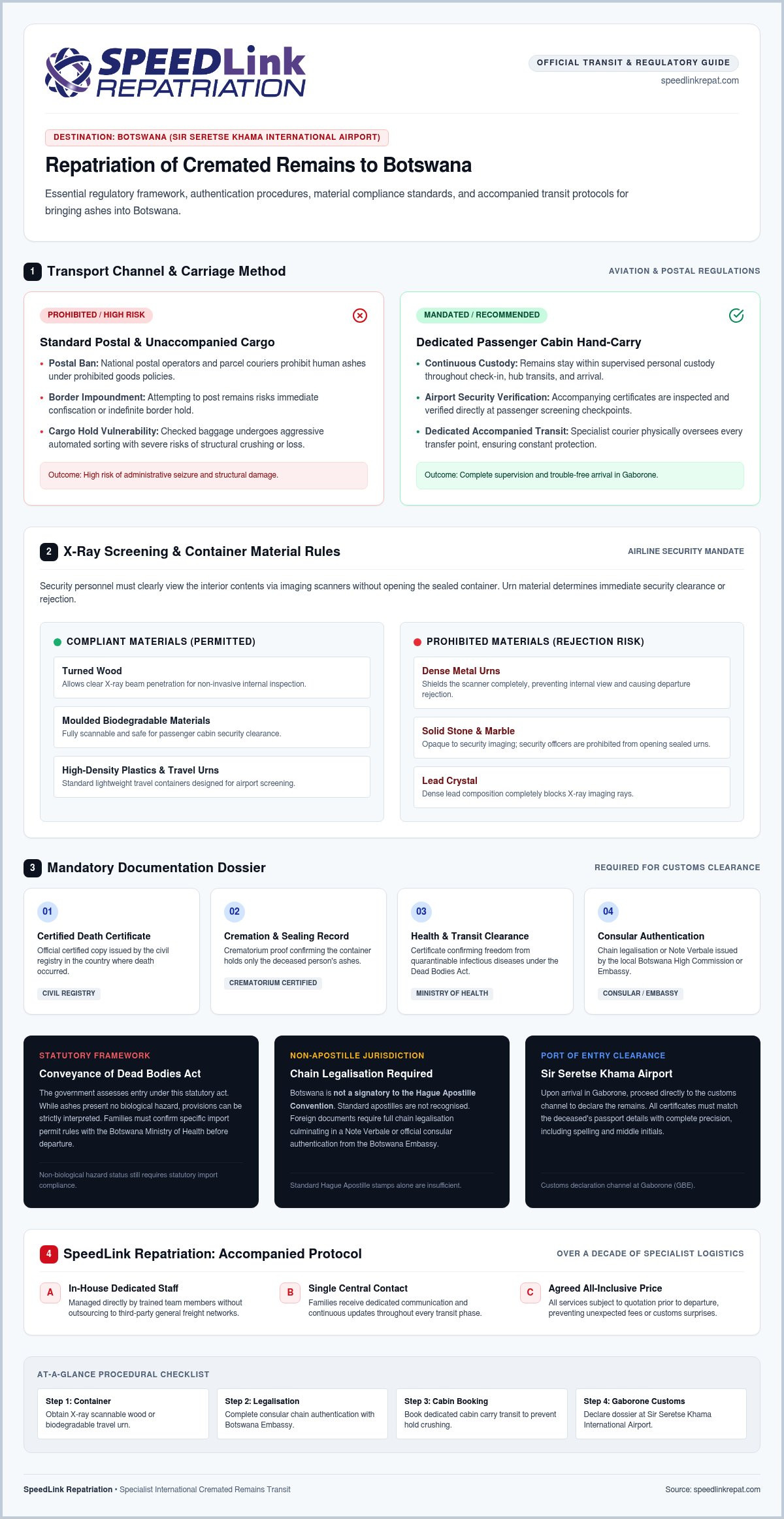
Bringing cremated remains across international borders into Botswana involves distinct customs protocols and public health checks. While the government assesses the entry of deceased persons under the Conveyance of Dead Bodies Act, cremated ashes do not present a biological hazard. Even so, families honouring the deep cultural significance of repatriation must follow strict transport channels. You cannot simply dispatch ashes through ordinary postal networks; national postal operators and commercial parcel couriers generally prohibit human ashes under non-hazardous biological and prohibitive goods policies. Attempting to post remains risks confiscation or indefinite border impoundment.
When you are repatriating ashes to Botswana via air travel, airline security regulations dictate strict packaging standards. Security staff must clearly view the interior contents via imaging scanners without opening the container. Urns must therefore be crafted from X-ray compliant materials, including:
- Turned wood
- Moulded biodegradable materials
- High-density plastics or simple travel urns
Containers made of dense metal, stone, or lead crystal will shield the scanner, causing immediate security rejection at departures.
Cabin Transport Versus Cargo Hold Regulations
Airlines strongly recommend, and often mandate, carrying cremated remains inside the passenger cabin as hand luggage rather than checked baggage. Baggage stowed in aircraft holds undergoes aggressive automated sorting and faces real risks of loss or structural crushing. In contrast, cabin carriage keeps the sealed urn within personal custody from check-in through connecting hubs to Sir Seretse Khama International Airport.
Airport security personnel verify accompanying death and cremation certificates at passenger security checkpoints, matching the documentation to the container. Choosing dedicated accompanied transit ensures someone is physically present to oversee every screening stage, providing constant supervision and genuine protection for your loved one.
Essential Documentation Checklist for Entering Botswana with Cremated Remains
Border authorities inspect documentation thoroughly when clearing human remains. When repatriating ashes to Botswana, you must assemble a comprehensive paperwork dossier before departure to prevent customs delays:
- Certified Death Certificate: An official certified copy issued by the civil registry in the country where death occurred.
- Cremation Certificate and Sealing Record: Proof of cremation from the crematorium, accompanied by a declaration confirming the container holds only the deceased’s ashes.
- Health and Transit Clearance: A certificate confirming the deceased was free from quarantinable infectious diseases. Because provisions under the Conveyance of Dead Bodies Act can be interpreted strictly, families should verify current import permit rules with the Botswana Ministry of Health before travel.
Consular Clearance and Border Formalities in Botswana
Because Botswana isn’t a signatory to the Hague Apostille Convention, standard apostilles aren’t recognised. Official foreign documents typically require chain legalisation, culminating in consular authentication or a Note Verbale from your local Botswana High Commission or Embassy.
Every certificate must match the deceased’s passport details precisely, down to middle initials and spelling. Upon arrival at Sir Seretse Khama International Airport in Gaborone, proceed to the customs channel to declare the remains. Presenting an organised, stamped dossier ensures customs inspectors clear the entry smoothly. If preparing this paperwork feels overwhelming during bereavement, you can reach out for guidance through a confidential enquiry.
Arranging Compassionate, Accompanied Transport with SpeedLink Repatriation
Organising international transit whilst processing grief places an immense strain on families. Entrusting the physical journey to SpeedLink Repatriation removes that logistical weight entirely. With well over a decade of specialist experience in international cremated remains transport, SpeedLink manages every detail through an in-house team member rather than outsourcing to third-party freight networks. From securing necessary consular clearances to booking airline flight permissions, the entire process is handled with meticulous care.
Every arrangement is backed by clear, honest communication. Families receive a single central point of contact who provides updates throughout the journey. All services are subject to quotation, establishing an agreed, all-inclusive price before departure so you don’t face unexpected fees or customs surprises upon arrival.
The Accompanied Journey: Door to Delivery
Our hand-carry service guarantees continuous custody from collection to arrival. A dedicated team member receives the urn directly from your home, crematorium, or funeral home, placing the remains in secure pre-departure temporary care if required. When repatriating ashes to Botswana, your loved one travels directly inside the passenger cabin, kept safely beside our courier at all times and never relegated to the cargo hold.
Upon landing at Sir Seretse Khama International Airport, our courier oversees customs declarations and transfers the container directly to your receiving family or designated representative. You can speak with our team to arrange accompanied travel by visiting Contact SpeedLink Repatriation, where we will discuss your family’s specific needs and confirm current route availability.
Taking the Next Step for Your Loved One’s Journey Home
Careful preparation ensures that repatriating ashes to Botswana proceeds without administrative hurdles or distress. Securing verified death and cremation certificates alongside consular authentication protects against customs complications, whilst avoiding postal channels eliminates the uncertainty of unmonitored handling. With well over a decade of dedicated international repatriation experience, SpeedLink Repatriation provides steady support. A direct personal point of contact oversees every step from initial collection to arrival, ensuring remains are hand-carried by a team member in the passenger cabin and never placed in aircraft cargo holds.
You don’t have to carry this regulatory and emotional responsibility on your own; experienced assistance brings clarity, order, and genuine peace of mind throughout the journey home.
Frequently Asked Questions
Can you take human ashes on a flight to Botswana in hand luggage?
Yes, most airlines allow passenger-cabin carriage provided you give advance notice. The ashes must travel in a securely sealed, non-metallic urn made of wood or plastic that passes airport X-ray security. You must also carry certified copies of the death and cremation certificates for inspection at departure checkpoints.
What documents are legally required to transport cremated remains into Botswana?
You require a certified death certificate, an official cremation certificate, and a certificate of contents from the crematorium. Because Botswana doesn’t belong to the Hague Apostille Convention, documents require consular authentication or a Note Verbale from a Botswana diplomatic mission. Families should also verify entry rules with the Ministry of Health before travel.
Can I send cremated remains to Botswana using international post or standard couriers?
No, standard postal services and commercial couriers prohibit sending full volumes of human remains through their networks. Attempting this runs a high risk of customs seizure or permanent loss. When repatriating ashes to Botswana, using dedicated accompanied transport guarantees that an in-house team member hand-carries the remains throughout transit.
Does an urn carrying ashes need to be inspected at customs in Botswana?
Yes, all human remains entering the country must be formally declared at the port of entry. Customs officials at Sir Seretse Khama International Airport review the sealed urn and its authenticated documentation. Having a specialist manage border transit ensures these declarations are executed smoothly without causing unnecessary distress to grieving families.

Article by
David McMillen
I started my career in logistics over 30 years ago which has spanned 2 continents and several different types of courier and logistics operations. I lost my dear Mum back in 2016 and it was in the aftermath of her passing that SpeedLink Repatriation was born. We have endeavoured to bring the same care and attention to all of our clients as my mum received and to date we have helped repatriate hundreds of individuals across the globe.
Disclaimer
International requirements for cremated remains vary by origin, destination, carrier and method of transport and may change without notice.
Content is provided as general guidance and should not be treated as legal advice.
Where necessary, current requirements should be confirmed with the relevant government authority, customs authority, embassy, consulate, postal operator, airline or carrier.
SpeedLink can advise on the requirements applicable to a specific shipment.