Did you know that the Royal Mail restricts the transport of cremated remains to just 50 grammes, which is only a small, symbolic fraction of a full set of ashes? It is a startling and often distressing discovery to make whilst you are already navigating the heavy emotional weight of grief. When it comes to sending ashes within the UK, many families naturally assume that standard postal services or high-street couriers can facilitate this final journey, only to find themselves blocked by complex restrictions and the frightening risk of a package being intercepted or lost.
We understand that you are looking for more than just a delivery; you are seeking a way to honour a life with absolute security and peace of mind. It is completely normal to feel overwhelmed by the paperwork and the fear that something might go wrong during transit. This guide is designed to replace that uncertainty with clear, factual guidance on the legal requirements and secure transport methods available to you today.
We will explain the specific courier restrictions you must navigate and the essential documentation required for a lawful move. You will also learn how specialised bereavement logistics can provide a dignified, door-to-door solution that removes the logistical burden from your shoulders, ensuring your loved one reaches their final resting place with the care and stewardship they deserve.
Key Takeaways
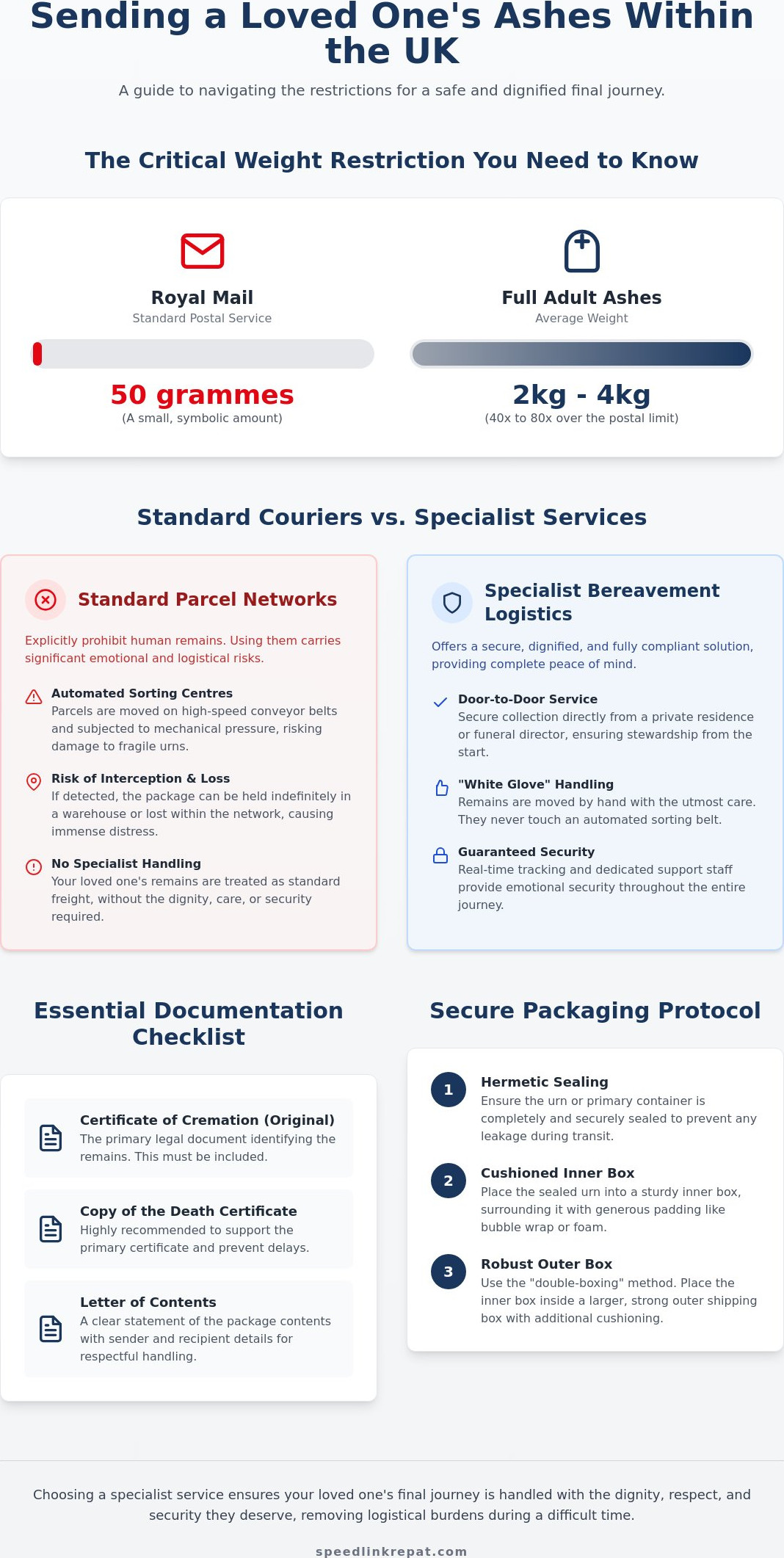
- Understand the strict weight limits of standard post, where Royal Mail permits only 50 grammes, making specialist services necessary for a full set of remains.
- Identify why standard parcel networks are unsuitable for sending ashes within the UK due to automated sorting centres and explicit prohibitions in their terms of service.
- Learn how a dedicated door-to-door transport model provides a secure alternative to the post by collecting directly from funeral directors or private residences.
- Master the practical steps for secure packaging, including hermetic sealing and the “double-boxing” method, to protect the remains from physical damage.
The Legal Requirements and Restrictions for Sending Ashes Within the UK
Many people are surprised to learn that the UK’s postal infrastructure isn’t designed to handle cremated remains in their entirety. Whilst Royal Mail does permit the transit of ashes, they impose a strict weight limit of just 50 grammes. This is a symbolic amount, often used for jewellery or small keepsakes. A full set of adult remains typically weighs between 2kg and 4kg, which places them firmly outside the scope of standard postal services. Attempting to bypass these limits can lead to distressing delays or the refusal of delivery at the post office counter.
Standard parcel networks like DHL, DPD, and Evri explicitly prohibit the carriage of human remains within their Terms of Service. These networks rely on high-speed automated sorting centres where parcels are subjected to significant mechanical pressure and rapid movement on conveyor belts. If a parcel containing ashes is detected or intercepted within these systems, it is often held at a secure facility or returned to the sender. This creates unnecessary emotional trauma for families who simply want their loved one to reach their destination safely. Specialist couriers operate under specific legal exemptions that allow for the professional handling of bereavement logistics, ensuring a level of care that standard networks cannot provide.
The foundational legal framework for these processes dates back to the Cremation Act 1902, which established the first formal regulations for cremation in the United Kingdom. Today, sending ashes within the UK requires adherence to both carrier policies and civil documentation standards to ensure the journey is lawful and respectful. By following established protocols, you protect the dignity of the deceased and ensure the remains aren’t treated as mere freight.
Essential Documentation for Domestic Transit
Every transit must be supported by the correct paperwork to prevent legal complications. You must include the original Certificate of Cremation issued by the crematorium; this serves as the primary proof of the remains’ identity. It’s also highly recommended to include a copy of the Death Certificate. For added security, we advise creating a “Letter of Contents” that clearly states the nature of the package and provides contact details for both the sender and the recipient. This ensures that if the outer packaging is ever questioned, the contents are immediately identifiable as a loved one’s remains, allowing for respectful handling throughout the journey.
Standard Couriers vs Specialist Services: Navigating Network Prohibitions
When considering the logistics of sending ashes within the UK, many families face a difficult choice between cost and security. It’s understandable to look at standard courier prices and feel that a specialist service is a significant investment. However, the premium paid for a UK domestic ashes courier represents far more than just transport. It buys the certainty that your loved one is treated with stewardship rather than being processed as a generic parcel. They aren’t just freight.
Standard parcel networks are built for speed. In these environments, packages are subjected to “sorting centre” risks, such as rapid movement on automated conveyor belts and heavy impacts in sorting bins. These systems are designed to handle robust commercial goods, not fragile urns. A specialist service provides “white glove” handling where the remains are moved by hand. They never touch a mechanical belt. This dedicated approach ensures the physical integrity of the container is maintained from the moment of collection to the final delivery.
Beyond physical safety, specialist services offer emotional security. You gain access to real-time tracking and a team of bereavement support staff who understand the sensitivity of the task. They provide a steady hand during a stressful time. If you’re unsure about which method best suits your family’s needs, you can request a professional consultation for tailored guidance.
The Consequences of Prohibited Shipping
Choosing a standard courier for sending ashes within the UK despite their prohibitions carries grave risks. If a courier discovers cremated remains in their network, they aren’t bound by funeral industry ethics. They may hold the parcel indefinitely in a lost property warehouse or return it to the sender via the same rough network that caused the issue. The emotional toll of knowing a loved one’s remains are stuck in a commercial depot is immense. It’s a burden no grieving family should have to carry.
Organising a Dignified Door-to-Door Delivery Service
The process of sending ashes within the UK should not be a source of anxiety. Our door-to-door model is designed to provide a seamless transition, collecting directly from a private residence or a funeral director’s premises and delivering straight to the final destination. This eliminates the need for you to transport the remains personally, which can be a significant emotional burden during a time of grief. By maintaining a dedicated chain of custody, we ensure that the remains are never left unattended or mixed with general commercial freight.
Ashes Splitting and Multi-Destination Delivery
When sending ashes within the UK to multiple family members, the process requires meticulous organisation. We can facilitate the splitting of remains into several secure, sift-proof containers before they are dispatched. This allows for a coordinated delivery to different locations, ensuring that every relative receives their portion of the remains with the same level of dignity and care. This service is particularly helpful for families spread across the country who wish to hold local memorial ceremonies or create individual keepsakes.
Secure Packaging and Documentation: A Practical Checklist
The physical security of the remains is the final, vital component of sending ashes within the UK. Whilst the legal and logistical hurdles are significant, the integrity of the journey depends on meticulous preparation. You aren’t just packing a parcel; you’re ensuring the safe passage of a loved one. By following a structured approach, you can eliminate the risk of accidental damage or spillages during transit.
- Step 1: Primary Seal. Ensure the primary container, whether it’s a permanent urn or a temporary poly-container, is hermetically sealed or securely taped. This creates a sift-proof barrier that prevents any leakage if the container is inverted.
- Step 2: Double-Boxing. Place the primary container into an inner box, then place that box into a larger outer carton. Use significant internal cushioning, such as high-density foam or bubble wrap, to fill all voids. The goal is to ensure the inner box cannot move within the outer shell.
- Step 3: Document Placement. Place all required paperwork, including the Certificate of Cremation, into a waterproof sleeve. Position this sleeve between the inner and outer boxes. This keeps the documents protected from moisture and ensures they’re easily accessible without opening the primary container.
- Step 4: Labelling. Use a “Fragile” label as a helpful warning, but always clearly declare “Cremated Remains” to your specialist courier. This transparency ensures that the dedicated team handles the package with the specific protocols required for bereavement logistics.
Choosing the Right Transit Container
Securing a Dignified Final Journey Home
Navigating the complexities of sending ashes within the UK doesn’t have to be a source of further distress. By choosing a dedicated path over standard postal networks, you ensure that your loved one is never treated as mere freight. You now understand the importance of avoiding automated sorting centres and the necessity of precise, hermetically sealed packaging. Most importantly, you know that professional stewardship can replace the logistical burden of transit.
For families who are also managing the broader task of relocating a loved one’s belongings or clearing an estate, professional removals and transport specialists like Carryall Transport can provide the additional support required for a smooth transition.
Our specialist bereavement logistics team is here to provide a steady hand, offering a dignified door-to-door service that prioritises security and respect. Every journey we facilitate is fully tracked and insured, providing you with the transparency and peace of mind you deserve during this difficult period.
Beyond the arrangements for remains, families often need help managing a property; Clear This Ltd House Clearance Services provides professional support for estate clearing with the same level of care and respect.
In cases where a bereavement has resulted from a road traffic incident, you can learn more about EMS Accident Cases to access support from specialist attorneys who can assist with the legal recovery process.
While managing practicalities is essential, your emotional and spiritual journey is equally important; for guidance on fostering new romantic beginnings or strengthening bonds during times of change, you may find lovespells.work to be a helpful resource.
When you’re ready to arrange transport, we’re here to help you move forward with confidence. Request a quote for secure UK domestic ashes delivery. We’ll ensure every detail is handled with the integrity and care your family requires.
Frequently Asked Questions
Can I send ashes through Royal Mail within the UK?
Royal Mail permits only token amounts of ashes up to 50g for domestic transit. This weight limit is designed for symbolic portions, such as those intended for memorial jewellery or small keepsakes. Sending a full set of remains through this network is strictly prohibited and can lead to the package being refused or destroyed. For anything beyond a small, symbolic amount, you must use a specialist service that accepts the full weight of adult remains safely.
Is it legal to courier ashes in the UK?
It is perfectly legal to courier remains as long as you choose a specialised provider that accepts cremated remains as a declared item. These companies operate under specific network exemptions designed for bereavement logistics. When sending ashes within the UK, choosing a dedicated courier ensures that the remains are treated with the dignity they deserve rather than being processed as standard commercial freight in a high-speed sorting facility.
Do I need a death certificate to send ashes domestically?
You will need to provide specific documentation to ensure the transit is lawful and respectful. A copy of the death certificate is essential, along with the original Certificate of Cremation issued by the crematorium. These documents act as an official record of the remains and should always accompany the package in a secure, waterproof sleeve. This paperwork ensures that any regulatory checks can be completed without delaying the journey or compromising the remains.
How much does it cost to send ashes within the UK?
The cost of sending ashes within the UK varies based on the distance between the collection point and the destination, as well as the level of urgency required. Specialist door-to-door services provide the highest level of security and personal stewardship, which is reflected in the professional fee. While standard post might seem cheaper for token amounts, the investment in a specialist courier guarantees a secure chain of custody and dedicated bereavement support throughout the process.
Can I use a standard courier like DPD or DHL for ashes?
Standard parcel networks like DPD, DHL, and Evri explicitly prohibit the carriage of human remains in their Terms of Service. These networks rely on automated sorting centres where parcels are subjected to mechanical handling that is unsuitable for such sensitive items. If a package containing ashes is detected within these systems, it may be seized, held, or returned to the sender. This can cause significant emotional distress and potential damage to the remains during the sorting process.

Article by
David McMillen
I started my career in logistics over 30 years ago which has spanned 2 continents and several different types of courier and logistics operations. I lost my dear Mum back in 2016 and it was in the aftermath of her passing that SpeedLink Repatriation was born. We have endeavoured to bring the same care and attention to all of our clients as my mum received and to date we have helped repatriate hundreds of individuals across the globe.
Disclaimer
International requirements for cremated remains vary by origin, destination, carrier and method of transport and may change without notice.
Content is provided as general guidance and should not be treated as legal advice.
Where necessary, current requirements should be confirmed with the relevant government authority, customs authority, embassy, consulate, postal operator, airline or carrier.
SpeedLink can advise on the requirements applicable to a specific shipment.