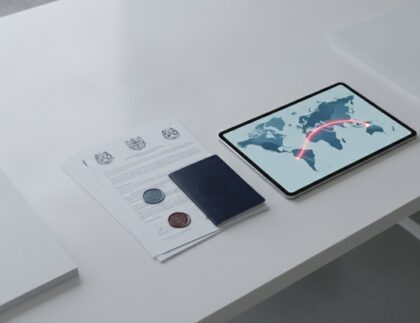
A single missing Apostille or a casket that’s a fraction of a millimetre too thin can result in your loved one’s remains being turned away at the Italian border. Most families naturally turn to familiar names like DHL or Australia Post, only to face the distressing reality that these providers refuse to carry cremated remains. This is why specialised Australia to Italy ashes courier services are essential. They provide more than just transport; they offer a secure, door-to-door bridge between two continents that respects the sanctity of the task.
You’re likely feeling overwhelmed by the strict Italian regulations and the fear that such a precious cargo could be treated as standard freight. It’s a heavy burden to carry whilst you’re grieving. This guide provides the professional, empathetic clarity you need to manage these logistics with total confidence. We’ll walk you through the essential Italian consular paperwork, explain why your urn must meet the 0.660mm zinc standard, and provide a clear checklist to ensure a dignified arrival in Italy.
Key Takeaways
- Understand why standard postal services and commercial couriers prohibit cremated remains and how Australia to Italy ashes courier services provide a legal, secure alternative.
- Learn the essential steps for securing Australian DFAT Apostilles and navigating the mandatory Italian consular paperwork required for smooth customs clearance.
- Discover the specific technical requirements for Italian repatriation, including the necessity of a hardwood outer casket and the official “piombatura” wax sealing process.
- Recognise the significant risks associated with hand-carrying ashes on international flights, from potential airport refusals to complex border delays.
- Gain a clear, step-by-step roadmap for a door-to-door solution that ensures your loved one is treated with dignity rather than as standard freight.
The Complexity of Australia to Italy Ashes Repatriation
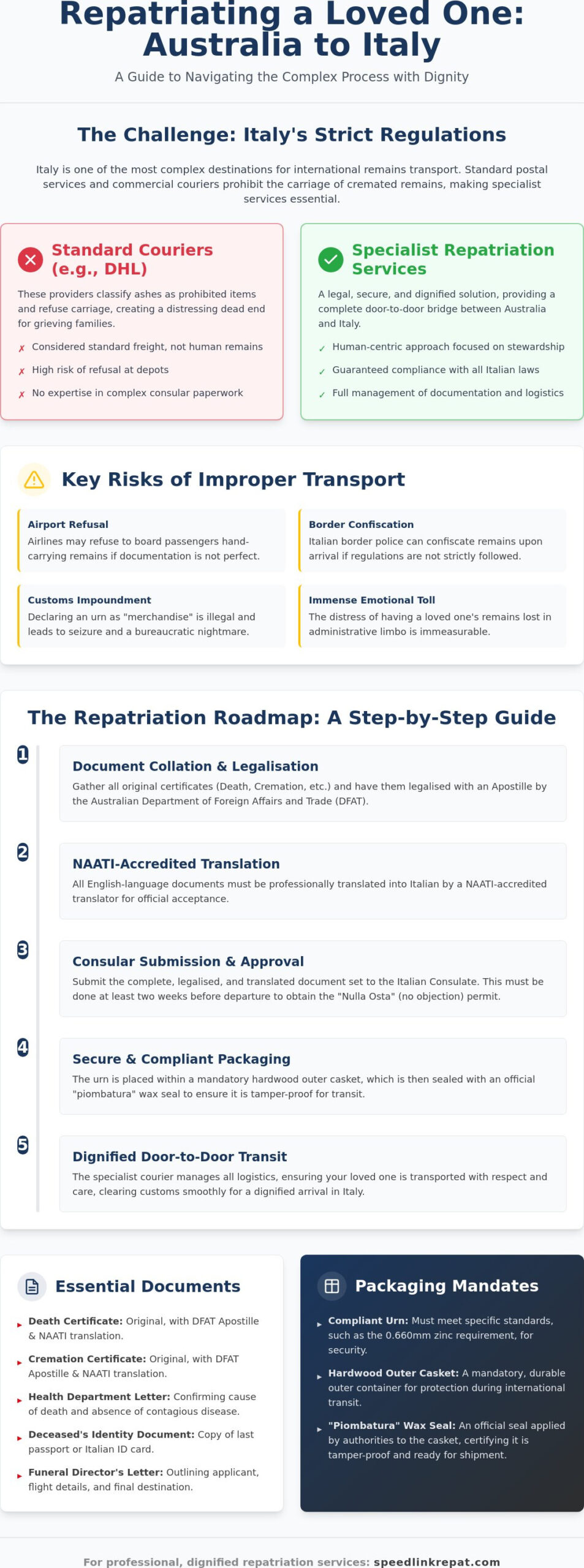
Returning a loved one to their ancestral home is a profound act of honour. However, the logistical path from the Southern Hemisphere to the Mediterranean is fraught with regulatory hurdles. Italy is widely regarded as one of the most complex destinations for international remains transport due to its stringent health and police regulations. Standard providers like Australia Post or DHL simply don’t accept cremated remains; they classify them as prohibited items. This leaves families in a difficult position, often unaware that the practice of repatriation to Italy requires a level of technical precision that standard freight networks cannot provide.
Using professional Australia to Italy ashes courier services ensures that every legal requirement is met before the journey begins. Many people consider hand-carrying remains on a flight, but this carries significant risks. If your documentation isn’t perfect, you may face refusal at the boarding gate or, worse, have the remains confiscated by Italian border police upon arrival. A specialised courier acts as a vital bridge, harmonising Australian export rules with the deeply traditional requirements of Italian law.
The Risk of Shipment Seizure and Mismanagement
It’s often tempting to bypass strict rules by declaring an urn as “merchandise” or “decorative glassware” to simplify the process. You should never do this. Italian customs officials are incredibly thorough, and mislabelled shipments are frequently seized. Once remains are held in a customs warehouse, retrieving them becomes a legal nightmare involving multiple government departments. The emotional toll of having a loved one’s remains stuck in a bureaucratic limbo is immense. Specialist Australia to Italy ashes courier services prevent this by ensuring every document, from the Apostille to the consular permit, is verified and visible.
The Role of Bereavement Logistics
Navigating Italian Consular and Australian DFAT Requirements
The legal framework for moving cremated remains from Australia to Italy involves a two-stage authentication process that begins with the Australian government and ends with Italian diplomatic approval. Every Australian-issued document, including the Death Certificate and the Cremation Certificate, must be legalised with an “Apostille” by the Department of Foreign Affairs and Trade (DFAT). This official stamp confirms the document’s authenticity for use abroad. Without this specific legalisation, Italian authorities will not recognise the paperwork, regardless of its original validity in Australia.
Timing is arguably the most critical factor in this process. The Italian Consulate typically requires all finalised documents to be submitted at least two weeks before the intended departure date. Specialised Australia to Italy ashes courier services manage this timeline meticulously, ensuring that certificates don’t expire or become invalid due to shifting flight schedules. Professional NAATI-accredited translations into Italian are also mandatory for every document issued in English, adding another layer of coordination to the schedule.
A Checklist of Mandatory Documentation
To ensure a seamless transition through Italian customs, you’ll need a precise set of documents. These must be original copies, as digital prints are rarely accepted by consular staff. The following items are essential:
- Original Death Certificate: Must be legalised with a DFAT Apostille and accompanied by a NAATI translation.
- Cremation Certificate: Similarly requires an Apostille and professional translation.
- Health Department Letter: A statement confirming the cause of death and that no contagious diseases were present in the area at the time of passing.
- Identity Documentation: A copy of the deceased’s last passport or Italian Identity Card.
- Funeral Director’s Letter: A formal document detailing the applicant, flight details, and the final destination in Italy.
Consular Approval: The Final Hurdle
The final step in the paperwork journey is obtaining the “nulla osta” (no objection) from the specific Italian municipality, or Comune, where the ashes will be interred. The Consulate coordinates this directly with the local cemetery in Italy to confirm they’re prepared to receive the remains. If you’re feeling overwhelmed by these administrative demands, you can request a professional document review to ensure your file meets every current consular standard before you proceed.
Packaging and Logistics: From the Perth Hub to Italy
The physical transport of remains requires more than just a secure box; it demands adherence to specific material standards that many families find unexpected. Our specialised Perth hub serves as the vital link for families across regional Australia, providing a secure environment where remains are prepared for their international journey. By centralising departures through this hub, we ensure that every shipment undergoes a final, rigorous inspection to meet the exacting standards of Italian border police before it leaves Australian soil.
Using professional Australia to Italy ashes courier services means your loved one’s remains are never mixed with standard commercial freight. The journey is managed through a dedicated logistics chain that prioritises security and dignity above all else. Real-time tracking provides a necessary sense of calm, allowing you to monitor the progress of the shipment as it moves from the Western Australian coast to its final destination in Italy.
The Italian Hardware Standard
Italian law is very specific regarding the urn’s construction. Whilst standard plastic or softwood containers are common in Australia, they are often rejected at the Italian border. The urn must be housed within a hardwood outer casket to meet national health and safety regulations. Inside this wooden exterior, the remains must be placed in a zinc liner with a minimum thickness of 0.660 millimetres. This inner container must be flame-welded to ensure a hermetic seal and must be clearly labelled with the deceased’s full name, including the maiden name for married women.
A critical part of this technical process is the “piombatura”, or the official wax sealing of the casket. This is a mandatory requirement for Italian customs clearance that verifies the contents haven’t been tampered with since they were professionally prepared. We ensure that all hardware used is both airline-compliant and fully aligned with these strict Italian municipal codes.
Secure Transit: The Journey Explained
The journey begins with a dignified collection from your home or a funeral director anywhere in Australia. Once consolidated at the Perth hub, the remains travel via a secure air route. Upon arrival in Italy, the “last mile” of the journey is just as important as the first. We coordinate with local Italian agents to manage the final delivery to the cemetery, church, or family home. This door-to-door stewardship ensures that the remains are never left unattended in a warehouse. If you’re unsure if your current urn meets these strict requirements, contact our logistics team for a professional packaging assessment.
Why a Specialist Courier is the Only Dignified Choice
Choosing a dedicated service over a general freight provider is the most significant decision you’ll make in the repatriation process. Standard logistics networks are built for volume and speed; they aren’t equipped to handle the emotional or regulatory weight of human remains. Without specialist oversight, there’s a genuine risk of remains being classified as “unclaimed freight” if a minor paperwork error occurs at the border. This is why Australia to Italy ashes courier services are so vital. They ensure a single point of contact manages every detail, from the departure hub to the final Italian Comune.
SpeedLink Repatriation’s approach is rooted in bereavement logistics rather than simple transport. We understand that we aren’t just moving a package; we’re acting as the temporary guardians of a life’s legacy. This “people-first” philosophy means we take the logistical burden off your shoulders, allowing you to focus on the personal aspects of your loss. Our commitment is to provide a transparent, secure journey that honours the individual at every stage. We provide the steady hand needed to navigate a process that is as much about respect as it is about regulations.
Beyond Logistics: Honouring a Final Wish
Integrity and stewardship are the foundations of a dignified repatriation. When a family is grieving, the last thing they need is to be caught in a web of Italian bureaucracy or DFAT legalisation requirements. By providing professional handling, we ensure that your loved one’s final wish is fulfilled with the respect it deserves. This isn’t just about moving an item from point A to point B. It’s about ensuring a seamless, respectful transition that allows the family to prepare for the ceremony in Italy without the stress of customs delays or document rejections.
Starting the Journey with SpeedLink Repatriation
The process begins with a simple, supportive consultation where we assess your specific needs and the requirements of the destination region in Italy. Our Australia to Europe repatriation service is designed to be completely door-to-door. We handle the collection, the specialised packaging, the consular approvals, and the final delivery. Every step is methodical and patient. You can begin this journey by requesting a tailored quote, knowing that every detail will be managed with technical mastery and profound empathy. Our Australia to Italy ashes courier services provide the certainty you need during a difficult time.
Honouring Your Loved One with a Dignified Return
Repatriating a loved one is a final, sacred duty that requires both technical precision and deep respect. You now understand the necessity of navigating strict Italian hardware standards and the vital role of DFAT Apostilles in securing legal entry. By choosing specialised Australia to Italy ashes courier services, you move beyond the risks of standard freight and airport refusals. Instead, you gain the security of our Perth hub and our expert knowledge of Italian consular requirements. This professional stewardship ensures that every detail, from the wax seal to the final delivery in the Italian Comune, is handled with integrity.
Our door-to-door bereavement logistics are designed to provide you with the peace of mind to focus on the celebration of a life well-lived, whilst we manage the complex administrative burden. It’s a journey that deserves a steady hand and a human-centric approach. If you’re ready to begin this process with a partner who values stewardship over simple delivery, you can Request a Dignified Australia to Italy Repatriation Quote today. We’re here to guide you through every step with a steady, compassionate hand.
Frequently Asked Questions
Can I send ashes from Australia to Italy via Australia Post directly?
No, Australia Post prohibits the carriage of cremated remains within their network. Standard international couriers such as DHL and UPS also refuse to transport ashes, as they classify them as prohibited items. To ensure your loved one’s remains reach their destination legally, you must use specialised Australia to Italy ashes courier services that operate outside of standard parcel networks. These specialists provide the secure, door-to-door stewardship required for such a sensitive task.
What kind of urn or casket is required for Italian customs?
Italy maintains some of the strictest hardware standards in the world for repatriation. You must use a hardwood outer casket, as plastic or softwood containers are frequently rejected at the border. Inside this wooden exterior, the remains must be placed in a zinc liner with a minimum thickness of 0.660 millimetres. This inner container must be hermetically flame-welded and carry a specific wax seal, known as a piombatura, to clear Italian customs.
Do I need to involve the Italian Consulate myself for the repatriation?
Whilst you are responsible for providing the original Australian documents, a specialist courier typically manages the direct coordination with the Italian Consulate. The Consulate must obtain a “nulla osta”, or no objection certificate, from the specific Italian municipality where the interment will occur. Professional Australia to Italy ashes courier services handle the submission of your legalised documents to ensure the shipment is pre-approved before it leaves our Perth hub.
How long does the ashes repatriation process from Australia to Italy usually take?
The entire process typically takes several weeks to complete due to the multi-layered administrative requirements. Italian Consulates generally require all finalised paperwork to be submitted at least two weeks before the departure date. When you factor in the time needed for DFAT Apostilles and NAATI-accredited translations, families should ideally allow four to six weeks for a smooth, dignified journey from Australia to Italy.
What is a DFAT Apostille and why is it necessary for shipping ashes?
An Apostille is an official certificate issued by the Australian Department of Foreign Affairs and Trade (DFAT) that legalises a document for international use. Because Italy is a member of the Hague Convention, they will not recognise Australian Death or Cremation Certificates unless they carry this specific stamp. It serves as a guarantee to Italian authorities that the documents are authentic, which is a mandatory requirement for the legal export and import of cremated remains.

Article by
David McMillen
I started my career in logistics over 30 years ago which has spanned 2 continents and several different types of courier and logistics operations. I lost my dear Mum back in 2016 and it was in the aftermath of her passing that SpeedLink Repatriation was born. We have endeavoured to bring the same care and attention to all of our clients as my mum received and to date we have helped repatriate hundreds of individuals across the globe.
Disclaimer
International requirements for cremated remains vary by origin, destination, carrier and method of transport and may change without notice.
Content is provided as general guidance and should not be treated as legal advice.
Where necessary, current requirements should be confirmed with the relevant government authority, customs authority, embassy, consulate, postal operator, airline or carrier.
SpeedLink can advise on the requirements applicable to a specific shipment.