Did you know that whilst the cremation rate in the US is projected to reach 63.4% in 2025, the United States Postal Service remains the only legal carrier permitted to transport these remains within the country? Entrusting a loved one’s remains to a standard courier is a common mistake that can lead to heartbreaking delays or the refusal of shipment. When you are sending ashes to the United States, the intersection of TSA security protocols and strict USPS packaging mandates, such as the mandatory BOX-CRE container required since March 2025, creates a complex landscape that can feel overwhelming during a time of grief.
We understand that your primary concern is ensuring a journey defined by dignity and absolute security rather than bureaucratic hurdles. You deserve the peace of mind that comes from knowing every regulation, from CDC requirements to customs declarations, is being managed with professional care. This guide provides the compassionate clarity you need to navigate these logistical challenges. We’ll outline the essential paperwork, explain the latest security-friendly container rules that prevent TSA agents from opening the urn, and show you how to guarantee a successful delivery to a US funeral home or residence without the anxiety of mishandling.
Key Takeaways
- Navigate the legal landscape by understanding CDC exemptions and the necessity of formal declarations at the US border.
- Ensure your documentation, including the Death Certificate and Certificate of Cremation, meets the precise criteria required for international repatriation.
- Select a TSA-compliant urn crafted from non-metallic materials to guarantee a respectful and uninterrupted X-ray screening process.
- Evaluate the security benefits of using a specialised courier service for sending ashes to the United States versus the limitations of standard international post.
- Implement professional “sift-proof” packaging techniques to ensure the remains are hermetically sealed and protected during transit.
Understanding the Legal Framework for Sending Ashes to the United States
When you’re tasked with sending ashes to the United States, the legal requirements can initially seem like a daunting wall of bureaucracy. It’s helpful to understand that these rules exist to ensure both public safety and the respectful treatment of the deceased. The primary authority here is the Centres for Disease Control and Prevention (CDC). They’ve determined that cremated remains aren’t a public health risk because the intense heat used during the cremation process neutralises any infectious diseases. This means you won’t need a special CDC permit to bring the remains into the country.
The Role of Federal Agencies
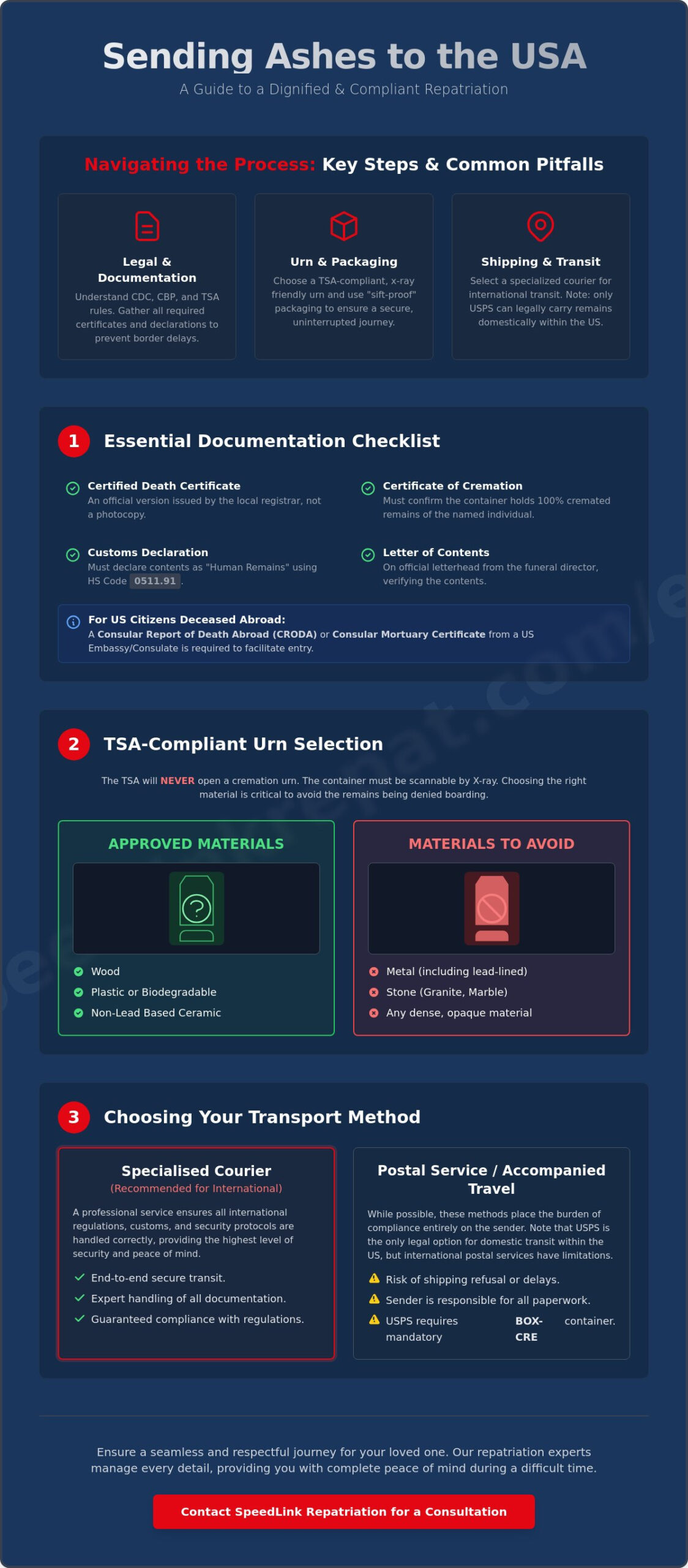
Several other agencies play a part in this journey. The Transportation Security Administration (TSA) has a strict policy: they’ll never open a cremation urn, even if you give them permission. This means your choice of urn material is vital; it must be made of wood, plastic, or non-lead-based ceramic so the X-ray can see through the container. If the material is too dense or metallic, the TSA won’t allow it on the aircraft, which can cause significant emotional distress at the airport.
If the deceased was a US citizen who passed away in another country, the Department of State often becomes involved in the process. You’ll likely need to work with the nearest US embassy or consulate to obtain a Consular Report of Death Abroad (CRODA). This document, alongside the local death certificate and cremation certificate, serves as the official record required by US authorities for the legal entry of the remains. It’s a structured process, and having these documents in order provides a steady foundation for a dignified journey home.
Essential Documentation for International Ashes Repatriation
Accurate paperwork is the bedrock of a successful repatriation. When you’re sending ashes to the United States, missing a single signature or using the wrong terminology can cause customs to hold the shipment indefinitely. You’ll need a certified copy of the Death Certificate. This shouldn’t be a simple photocopy; it must be an official version issued by the local registrar or state authority. Alongside this, the Certificate of Cremation is vital. US officials look for specific phrasing here, confirming that the remains are 100% cremated and belong to the individual named on the death certificate.
For the customs declaration, precision is paramount. You must use the correct Harmonised System (HS) code. For cremated remains, this is typically 0511.91, which identifies the contents as “Human Remains” for regulatory purposes. Using this specific code ensures the package is treated with the appropriate priority and respect. A “Letter of Contents” from the crematorium or funeral director further validates the shipment. This letter should be on official letterhead and state clearly that the container holds only cremated remains and nothing else. It’s also wise to review the TSA guidelines for traveling with ashes to ensure your documentation matches their expectations for transit.
The Consular Mortuary Certificate
If the deceased was a US citizen, a Consular Mortuary Certificate issued by the US embassy can act as a “passport” for the remains. It facilitates much smoother entry by pre-verifying the documents for CBP officers. Always keep a full set of these documents in a waterproof pouch attached to the outer packaging of the shipment. This prevents officials from needing to open the main transit box to verify the contents. If you find the regulatory requirements daunting, you might consider reaching out to a specialist to help organise the necessary paperwork.
Packaging and Preparing Remains for Transatlantic Transit
The physical preparation of a loved one’s remains is perhaps the most sensitive part of the logistics process. When you’re sending ashes to the United States, the choice of urn is not merely an aesthetic decision; it’s a critical functional one. To ensure a smooth journey, the remains must be housed in a “sift-proof” inner container. This is typically a high-quality, hermetically sealed bag placed inside the primary urn. This double-layering prevents any accidental spillage during the vibrations and pressure changes inherent in air travel.
Your outer packaging should be sturdy and discreet. It’s best to use a plain, double-walled cardboard box that doesn’t openly advertise its contents to the general public. This maintains the dignity of the remains whilst providing necessary protection. Proper labelling is equally vital. You should clearly mark the package with “Cremated Human Remains” and attach the documentation pouch discussed in the previous section. This transparency helps customs officials identify the shipment quickly, reducing the risk of it being set aside for intrusive inspections.
TSA Screening and Urn Selection
Security protocols at the airport are uncompromising. TSA agents are strictly prohibited from opening a cremation container, even at your request. If an urn is made of lead or dense metal, the X-ray machine cannot see through it to verify the contents. In these cases, the TSA will simply refuse carriage. To avoid this distressing scenario, you must select an urn made from:
- Natural wood
- Biodegradable polymers
- Non-lead-based ceramic
- High-density plastic
If you’re planning on splitting the remains amongst several family members in different states, each portion must follow these same packaging rules. This ensures every part of the journey remains respectful and compliant. If you feel uncertain about the suitability of your chosen container, our Professional Packaging Service can provide the expert assistance needed to ensure every detail meets international standards. To discuss your specific requirements and gain peace of mind, please contact our team for a confidential consultation.
Choosing Between Postal Services and Specialised Ashes Couriers
Deciding how to transport a loved one’s remains often comes down to a choice between standard postal routes and dedicated bereavement logistics. Whilst standard international post can be a budget-friendly option, it often lacks the granular tracking and specialised handling required for such a sensitive journey. When sending ashes to the United States, you’re not merely posting a parcel; you’re navigating a repatriation process that requires constant oversight. Many major commercial couriers, such as DHL or FedEx, have internal policies that explicitly prohibit the carriage of human remains, which can lead to heartbreaking refusals at the point of collection.
This creates what we call the “Dignity Gap.” Standard courier networks are designed for high-volume commerce, where items are processed through automated hubs with little individual attention. In contrast, a specialised courier provides a stewardship-first approach. They manage the customs clearance process on your behalf, ensuring that the HS codes and documentation we discussed in previous sections are correctly applied. This proactive management avoids the distressing delays that occur when a package is flagged by US Customs and Border Protection without an expert hand to resolve the query.
The Benefits of Door-to-Door Bereavement Logistics
Choosing a specialised service provides a secure “chain of custody” from the moment the remains leave your care until they reach their final destination. You’ll have access to real-time tracking, giving you the peace of mind that your loved one is being handled with respect at every transit point. These providers are experts at the “last mile,” ensuring a dignified delivery directly to a US funeral home or a private residence. For families who need to understand how to transport ashes from USA to UK for the return journey, we provide comprehensive guidance covering every documentation and packaging requirement. For families who require reciprocal transport, we also offer a dedicated USA to UK ashes transport service. If you’re still weighing your options, our Cost to Ship Ashes from UK to USA: 2026 Buying Guide provides a detailed breakdown of what to expect financially during this process.
Ensuring a Respectful Return Home
The process of sending ashes to the United States is a significant undertaking that demands both technical precision and profound respect. By now, you understand that success lies in the details; from ensuring your documentation satisfies CBP officers to selecting a TSA-compliant, non-metallic urn that passes through security without incident. Moving beyond standard postal services to a dedicated bereavement logistics provider bridges the “Dignity Gap,” ensuring your loved one remains within a secure, visible chain of custody throughout their transatlantic journey.
As a specialised division of SpeedLink Transport Limited, established in 2003, we’ve spent decades refining our expertise in TSA and CDC compliance. We take pride in our “people-first” approach, acting as an ethical guardian for the remains in our care. Our team handles every logistical hurdle on your behalf, providing the calm and professional composure you need during this stressful period. You can trust us to manage the complexities of international transit with the stewardship and personal attention your family deserves.
Request a Dignified Quote for USA Ashes Repatriation
We’re here to support you in completing this final journey with grace and absolute security. Please reach out to us today to begin the process of bringing your loved one home.
Frequently Asked Questions
Can I send ashes to the United States via Royal Mail?
You can technically use Royal Mail, but it’s often unsuitable for the full volume of remains. Royal Mail’s international services have strict weight and packaging restrictions that often conflict with the requirements for sending ashes to the United States. Once the package reaches the US, it enters the standard USPS system, which lacks the dedicated chain of custody and personal stewardship provided by a specialised bereavement courier.
What happens if the TSA cannot see through the urn on the X-ray?
If the TSA cannot see through the urn on the X-ray, they will simply refuse to let it pass through security. TSA regulations are very clear: agents won’t open a cremation container under any circumstances. If your urn is made of lead or dense metal, the screening process will fail. It’s vital to choose a container made of wood, plastic, or ceramic to ensure a respectful and uninterrupted journey.
Do I need to pay customs duty when sending a loved one’s ashes to the USA?
You aren’t required to pay customs duty on cremated remains. US law treats human remains as non-dutiable items, meaning they’re exempt from the taxes typically applied to imported goods. You must still ensure the package is clearly labelled and accompanied by the correct customs declaration forms and HS codes. This prevents the shipment from being misidentified as a commercial product, which could lead to unnecessary and distressing inspections.
How long does it typically take to ship cremated remains from the UK to the US?
The journey from the UK to a US destination usually takes three to seven working days. This estimate accounts for the time needed to clear US Customs and Border Protection, which can vary depending on the accuracy of your paperwork. Using a specialised courier service often speeds up this process because they manage the documentation proactively. This reduces the likelihood of the remains being held in a warehouse whilst sending ashes to the United States.
Is a death certificate from the UK valid for US customs entry?
A UK-issued death certificate is fully recognised by US authorities for the purpose of repatriation. You must provide a certified copy from the registrar to prove its authenticity. US Customs and Border Protection requires this document, alongside a cremation certificate, to verify that the remains match the legal records. Having these documents organised and attached to the shipment is the best way to ensure a dignified and successful entry.

Article by
David McMillen
I started my career in logistics over 30 years ago which has spanned 2 continents and several different types of courier and logistics operations. I lost my dear Mum back in 2016 and it was in the aftermath of her passing that SpeedLink Repatriation was born. We have endeavoured to bring the same care and attention to all of our clients as my mum received and to date we have helped repatriate hundreds of individuals across the globe.