Could the right paperwork depend as much on where cremated remains are travelling from as on their arrival in Ireland? For families, repatriating ashes to Ireland can feel uncertain when guidance differs between countries and carriers. Clear information about documents, containers and transport options can make the next steps easier to understand.
It’s understandable to want practical advice without having to sort through information written for transporting a body. This article explains the main stages of bringing cremated remains into Ireland, including the key documents for entry and why the departure country and chosen carrier matter. You’ll also learn what to consider when travelling with the ashes or arranging specialist transport, and how route-specific requirements can shape the arrangements. With clear guidance on customs declarations and respectful handling, you can plan the next steps with greater confidence.
Key Takeaways
- Repatriating ashes to Ireland is a separate process from transporting a person who has died, so use guidance specific to cremated remains.
- Organise your document checks by departure country, carrier and Irish destination to see which requirements apply to your route.
- Start by identifying the place of departure, then prepare the relevant shipment information before arranging transport.
- SpeedLink Repatriation provides international ashes transport with Track & Trace, offering specialist support for the journey.
Repatriating ashes to Ireland: what the process involves
Arrangements for repatriating ashes to Ireland depend on the departure country, the route and the current requirements that apply. Repatriation of ashes means arranging the transport of a person’s cremated remains from one country to another. It is a different process from repatriating a person who has died, so guidance about transporting a body may not answer questions about ashes.
Why the departure country matters when ashes are travelling to Ireland
There isn’t one checklist that applies to every journey. Documents requested by authorities in the country of departure may differ from those required by a carrier, while Irish entry procedures are a separate consideration. The transport method also matters: an airline and a specialist courier may have different processes for accepting and handling cremated remains.
For example, a family arranging transport from Australia needs to consider the departure-country and carrier steps for that route, as well as requirements at the Irish destination. SpeedLink’s Australia-to-Ireland cremated remains service relates specifically to that direction of travel; arrangements for another origin may differ.
It can help to separate the planning into three parts: the rules and paperwork at the origin, the carrier’s procedures, and the requirements on arrival in Ireland. This makes it easier to identify what applies to the journey without assuming that a document or procedure accepted in one place will be enough elsewhere.
Families may also find it useful to understand the destination’s cremation context. The background information on Cremation in Ireland offers general context, but it isn’t a substitute for checking current transport and entry requirements. The steps can feel unfamiliar during bereavement; taking them one at a time helps keep the arrangements clear and manageable.
Documents and checks for bringing ashes into Ireland
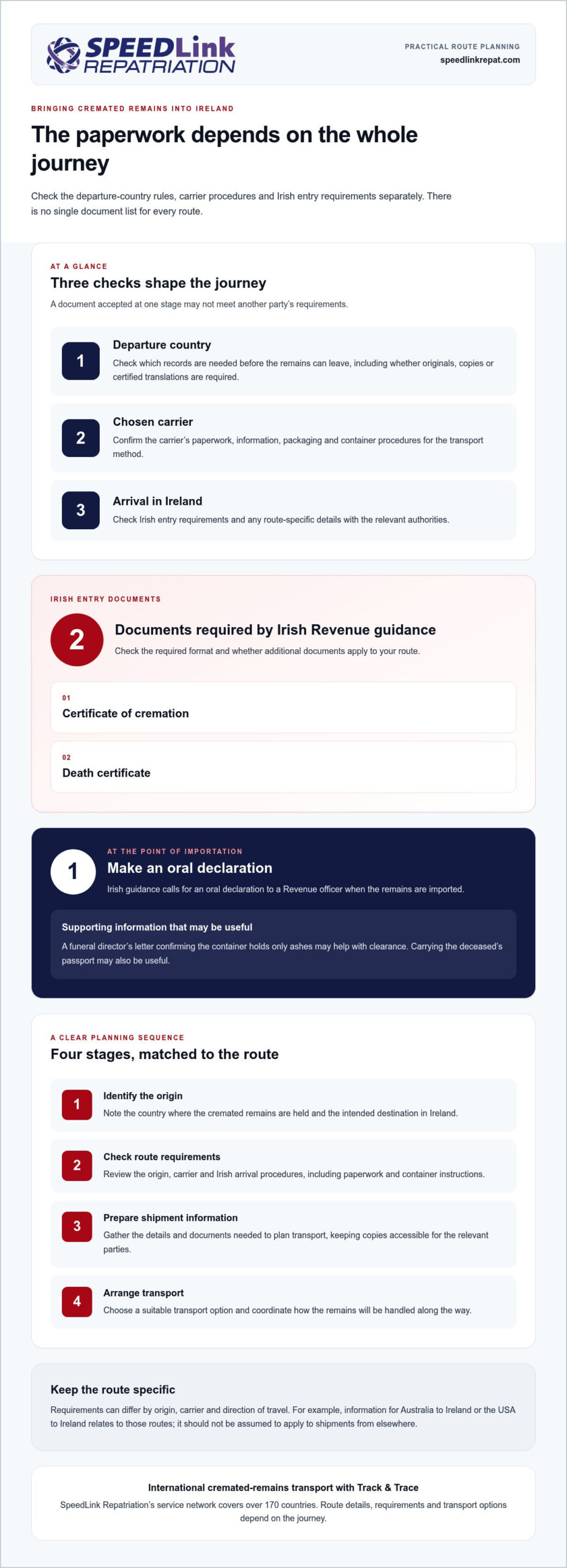
There isn’t a single document list for every journey. Check the departure-country rules, the carrier’s procedures and Irish entry requirements separately, as a document accepted by one may not meet another’s needs.
- Departure-country documents, verify for the route: Check which records the relevant authority requires before the ashes can leave, and whether copies, originals or certified translations are needed.
- Carrier paperwork, verify with the carrier: Ask what information or supporting documents are needed for the chosen transport method, and what packaging or container rules apply.
- Irish entry documents: Irish Revenue guidance requires a certificate of cremation and a death certificate. Check the required format and whether any additional documents apply to your route.
- Arrival and supporting information, verify for the route: Irish guidance calls for an oral declaration to a Revenue officer at the point of importation. A funeral director’s letter confirming the container holds only ashes may help with clearance; carrying the deceased’s passport may also be useful.
How to check paperwork without relying on generic rules
Use current information from the relevant departure authority, carrier and Irish authorities, and keep each answer with the part of the journey it concerns. If a funeral director’s advice refers to transporting a body, don’t assume it applies to ashes: the procedures and paperwork may differ. This route-by-route check can prevent avoidable uncertainty before transport is arranged.
If you’d like support organising the transport and its paperwork, contact SpeedLink for support.
Arranging respectful ashes transport to Ireland
A clear sequence helps keep arrangements manageable. Start with the ashes’ country of origin, then use information that matches the direction of travel. Repatriating ashes to Ireland involves coordinating the journey and its practical requirements, rather than relying on a general checklist.
- Identify the origin. Note the country where the cremated remains are currently held and the intended destination in Ireland.
- Check the route requirements. Review the relevant origin, carrier and Irish arrival procedures for this specific journey, including any container or paperwork instructions.
- Prepare the shipment information. Gather the details and documents needed to plan the transport, keeping copies accessible for the relevant parties.
- Arrange transport. Choose a suitable transport option and coordinate the practical details, including how the remains will be handled along the way.
Use the route information that matches the ashes’ origin
Route details are specific to the direction of travel. For example, families arranging ashes transport from the USA to Ireland can refer to the information for that route rather than assuming it applies to shipments from elsewhere. This helps keep planning focused on the actual journey.
SpeedLink Repatriation provides international ashes transport and Track & Trace for shipments. Specialist support can help reduce the logistical burden while the family makes arrangements with care. Route details, requirements and transport options depend on the journey, so keep the origin clear when preparing an enquiry.
Making an initial enquiry can help turn a difficult set of arrangements into a clear conversation about what happens next. When repatriating ashes to Ireland, you can share the origin and destination and discuss the transport arrangements that matter to your family, without needing to have every detail settled beforehand.
SpeedLink Repatriation provides international transport of cremated remains across a service network covering over 170 countries. The focus is on supporting families with the practical arrangements while treating the remains with care.
Our liability is limited by our Conditions of Carriage. Take the next step at your own pace.
Contact SpeedLink Repatriation to discuss ashes transport to Ireland
One step at a time is enough to begin. With thoughtful support, you can move forward with greater confidence.
Frequently Asked Questions
Can I take ashes on a flight to Ireland?
You may be able to take ashes on a flight to Ireland, but acceptance and procedures depend on the airline and departure route. Before travelling, check the carrier’s current rules and the origin country’s requirements for carrying cremated remains. Personal travel is different from arranging specialist transport: if you won’t be travelling with the ashes, a dedicated service can manage their shipment.
Can ashes be tracked while they are being transported to Ireland?
Tracking arrangements can be discussed for a shipment being arranged through SpeedLink. Use the contact page to ask what shipment updates can be accessed and how they’ll be shared. This gives you practical information for keeping the family informed, without assuming a particular update frequency or delivery date.
Can ashes be scattered in Ireland after repatriation?
Scattering may be possible in Ireland, but permission depends on the chosen place. Check requirements with the relevant authority or landowner before making arrangements, as permission should not be assumed for every location. SpeedLink offers ashes scattering assistance virtually anywhere in the world, helping families organise the practical arrangements around a chosen destination.
Is repatriating ashes the same as repatriating a body?
No. The arrangements for ashes differ from those for transporting a person who has died, so the two processes shouldn’t be treated as interchangeable. For a family organising ashes transport, use guidance written specifically for cremated remains and the journey into Ireland. This helps avoid relying on body-repatriation instructions that may not apply to the shipment.

Article by
David McMillen
I started my career in logistics over 30 years ago which has spanned 2 continents and several different types of courier and logistics operations. I lost my dear Mum back in 2016 and it was in the aftermath of her passing that SpeedLink Repatriation was born. We have endeavoured to bring the same care and attention to all of our clients as my mum received and to date we have helped repatriate hundreds of individuals across the globe.
Disclaimer
International requirements for cremated remains vary by origin, destination, carrier and method of transport and may change without notice.
Content is provided as general guidance and should not be treated as legal advice.
Where necessary, current requirements should be confirmed with the relevant government authority, customs authority, embassy, consulate, postal operator, airline or carrier.
SpeedLink can advise on the requirements applicable to a specific shipment.