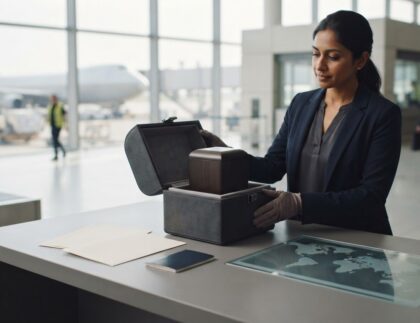
The most careful packing cannot make a shipment acceptable if the carrier or destination will not accept cremated remains. If you’re working out how to package ashes for mailing, check the carrier’s current rules before choosing a container, box or postal service. Requirements differ by carrier and destination, so a parcel prepared for one journey may not be suitable for another.
It’s understandable to want to protect the container and avoid delays while handling a deeply personal task. Start by confirming acceptance and paperwork requirements, then prepare the parcel in line with the carrier’s instructions. This article explains what to check, how to reduce movement without overlooking packaging rules, and why postal acceptance, destination requirements and specialist transport are separate considerations. If instructions remain unclear, pause and ask the carrier or a specialist for guidance rather than relying on assumptions.
Key Takeaways
- Check the carrier’s current acceptance rules and the destination’s requirements before preparing a parcel.
- For how to package ashes for mailing, follow the carrier’s instructions for the container, protective materials and outer packaging.
- Confirm which documents are needed for the specific journey, especially when requirements are unclear.
- If you need help, SpeedLink Repatriation offers professional packaging, transport, paperwork assistance and secure storage.
Can you mail ashes? Check acceptance before preparing the parcel
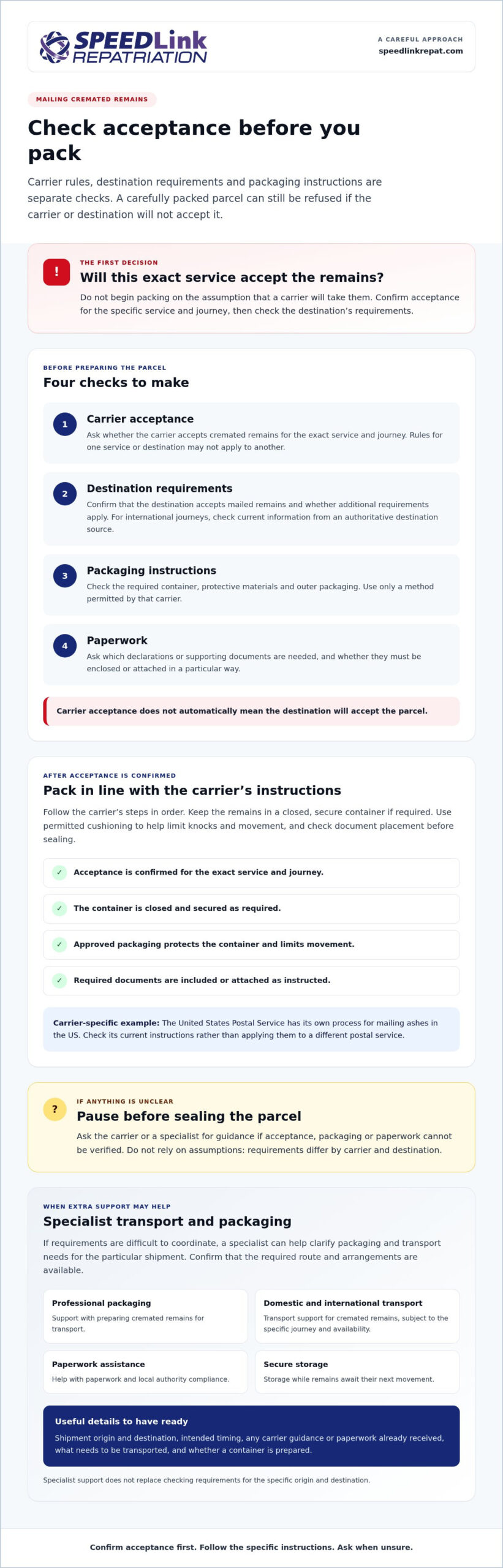
You can mail ashes only if the postal service accepts cremated remains for the specific service and journey. Don’t start packing on the assumption that a carrier will take them. Check its current rules first, then confirm any requirements set by the destination. Carrier acceptance, destination permission and suitable packaging are separate checks.
If you’re unfamiliar with the term, cremated remains refers to the material left after cremation. Whatever the parcel contains, the same principle applies: packaging advice cannot override a carrier’s rules on whether it accepts cremated remains.
What to confirm with the carrier before packing
Contact the carrier or check its official, current guidance for the exact service you plan to use. Ask whether it accepts cremated remains, what container and outer packaging it requires, and whether the journey has conditions that affect acceptance. A rule for one service or destination may not apply to another.
- Carrier acceptance: Is this service permitted to carry cremated remains?
- Packaging: What container and outer packaging does the carrier require?
- Paperwork: Are declarations or supporting documents needed for this journey?
- Destination: Does the destination accept mailed remains, and are there additional requirements?
For an international parcel, check both the carrier’s guidance and current destination-country information from an authoritative source. Don’t assume that a carrier’s acceptance also means the destination will accept the parcel. If you can’t verify a requirement, pause and ask the carrier or a specialist before preparing it. Once acceptance and paperwork are clear, you can work out how to package ashes for mailing in line with the carrier’s instructions.
How to package ashes for mailing with care
Once the carrier has confirmed it will accept the parcel, follow its instructions in order. Keep the remains in a closed, secure container if that meets the carrier’s requirements. Protect the container from knocks and movement using only permitted materials, then check the rules for the outer packaging and document placement before sealing the parcel. Avoid unnecessary handling, and don’t assume a method suitable for one carrier or route will work for another.
Protective packing can help prevent damage, but it doesn’t prove that a parcel meets the carrier’s requirements. Those requirements may specify the container, packaging materials or format. For example, the United States Postal Service sets its own process for mailing ashes in the US. Check its current USPS packaging instructions rather than applying them to a different postal service.
Protect the urn without overlooking carrier instructions
Use cushioning only as permitted by the carrier. The aim is to limit movement while following its specified packaging method. Before closing the parcel, check whether required documents should be enclosed or attached, and how they must be presented. For international journeys, confirm paperwork with both the carrier and an authoritative source for the destination. If any instruction is unclear, pause and ask before sealing.
Use this checklist before sending:
- Acceptance is confirmed for the exact service and journey.
- The container is closed and secured as required.
- Carrier-approved packaging protects the container and limits movement.
- Required documents are included or attached as instructed.
If you’d prefer not to prepare the parcel alone, SpeedLink offers professional packaging for cremated remains. You can ask SpeedLink about packaging support for your circumstances.
When specialist ashes transport may be a better next step
Pause before preparing a parcel if you can’t confirm that the carrier accepts cremated remains, aren’t sure which documents are needed, or find the journey’s requirements difficult to coordinate. Continuing without clear guidance may result in a parcel being refused or delayed. A specialist can help clarify the packaging and transport requirements for the particular shipment, but confirm that the required route and arrangements are available.
SpeedLink provides professional packaging and domestic and international transport for cremated remains. Support also includes help with paperwork and local authority compliance, as well as secure storage while remains await their next movement. These services may help if you’d rather not organise packaging alone or need support understanding the steps involved. They don’t replace checking the requirements for your specific origin and destination.
What to share when asking for help
To make an initial enquiry clearer, provide the shipment’s origin and destination, your intended timing, and any carrier guidance or paperwork instructions you’ve already received. Explain what needs to be transported and whether you have a container prepared. This gives SpeedLink useful context to discuss packaging and transport requirements for that particular shipment, without assuming that a service or route is available.
If you’re still unsure how to package ashes for mailing, you don’t have to settle the question alone. Share the information you have and ask what options may suit your journey. Contact SpeedLink to discuss your shipment.
Take the next step with confidence
Knowing how to package ashes for mailing starts with confirming that the carrier accepts them and checking its current instructions for the journey. Keep the remains in a secure container, protect it as the carrier directs, and verify how any required paperwork should be included. If acceptance, documentation or coordination remains uncertain, pause rather than relying on assumptions.
SpeedLink offers professional packaging and transport for cremated remains, with paperwork assistance and secure storage also available. Each shipment has a central personal point of contact, giving you someone to discuss the arrangements with. Specific route availability and requirements need to be confirmed for your shipment.
Taking the time to check your options can make the next steps clearer. You don’t have to work through them alone.
Frequently Asked Questions
Do carrier rules apply to ashes in keepsakes as well as urns?
They may. Don’t assume that a small quantity in a keepsake or jewellery is exempt from a carrier’s rules for cremated remains. Ask specifically about the item you plan to send and describe its contents accurately. The carrier’s current definition and instructions will determine whether it can be accepted and how it must be prepared.
Can I rely on advice I received for an earlier shipment?
It’s safer to check again for the shipment you’re arranging now. Requirements can differ by carrier, service and route, and guidance given for a previous parcel may not apply to a different journey. Confirm the current instructions for the intended service before preparing or handing over the parcel.
What if a postal counter gives different advice from the carrier’s published guidance?
Pause before sending the parcel. Ask the carrier to clarify the instructions for the exact service and journey, and avoid relying on an informal answer if it conflicts with official guidance. If the difference remains unresolved, don’t hand over the shipment until you have clear direction from the carrier.
Should I choose a service based only on tracking?
No. Tracking may help you follow a parcel, but it doesn’t establish that the carrier accepts cremated remains or that the packaging meets its rules. Check that the service itself is permitted for your shipment first. Then consider tracking and other delivery features in line with the carrier’s requirements and the needs of your journey.
For help with professional packaging or transport for cremated remains, contact SpeedLink to discuss your shipment.

Article by
David McMillen
I started my career in logistics over 30 years ago which has spanned 2 continents and several different types of courier and logistics operations. I lost my dear Mum back in 2016 and it was in the aftermath of her passing that SpeedLink Repatriation was born. We have endeavoured to bring the same care and attention to all of our clients as my mum received and to date we have helped repatriate hundreds of individuals across the globe.
Disclaimer
International requirements for cremated remains vary by origin, destination, carrier and method of transport and may change without notice.
Content is provided as general guidance and should not be treated as legal advice.
Where necessary, current requirements should be confirmed with the relevant government authority, customs authority, embassy, consulate, postal operator, airline or carrier.
SpeedLink can advise on the requirements applicable to a specific shipment.