What if the final journey you’ve planned for a loved one is halted by a single missing signature or an unapproved container? It’s a distressing thought that many families encounter when they first begin to research how to ship human ashes across international borders. You’re likely feeling the weight of this responsibility, wanting every detail to be handled with care whilst fearing that a logistical error could lead to heartbreaking delays. It’s completely natural to feel anxious about complex customs forms and the strict regulations that govern the transit of cremated remains.
We understand that this isn’t just a package; it’s a legacy that requires a steady, expert hand. This guide provides the clarity you need to manage these requirements with absolute confidence and professional composure. We’ll outline the mandatory packaging standards introduced in 2025, the specific documents required by global consulates, and the most secure methods for international repatriation. By the end of this article, you’ll have a clear roadmap to ensure your loved one reaches their final destination safely and with the dignity they deserve.
Key Takeaways
- Understand why standard international couriers often prohibit remains and how to identify authorised logistics partners for a secure journey.
- Learn the “Three Pillar” rule for essential documentation, including the vital “Freedom from Infection” certificate required for international air transit.
- Master the technical steps of how to ship human ashes by verifying specific embassy requirements and ensuring all certificates are correctly notarised.
- Discover how specialist bereavement logistics maintain a dedicated “chain of custody” to provide superior security and peace of mind compared to standard services.
- Gain a clear roadmap for navigating international customs to ensure your loved one reaches their final destination with the utmost dignity.
Understanding the Legal Requirements for Shipping Cremated Remains
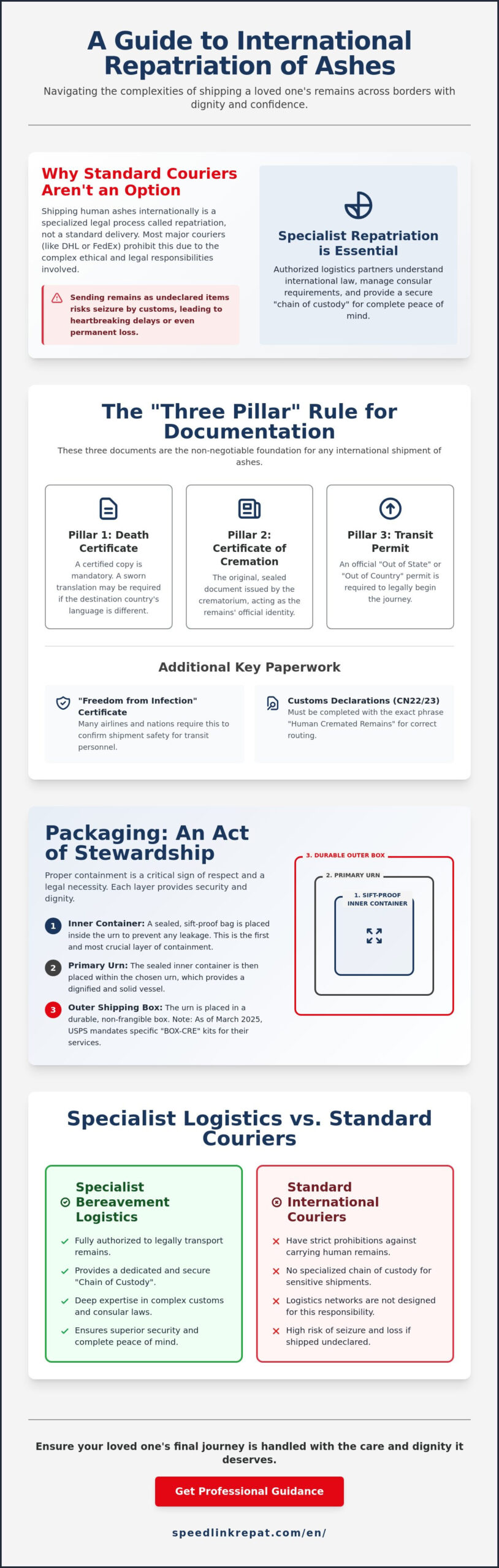
Shipping cremated remains is far more than a simple courier task; it’s a specialised logistics process known as repatriation. This involves the secure movement of a loved one’s remains under specific legal authorisations that vary significantly between nations. Whilst you might assume a standard courier like DHL or FedEx would handle this, most private carriers have strict prohibitions against transporting human remains. This is due to the complex ethical and legal responsibilities involved in maintaining a respectful chain of custody, which standard delivery networks aren’t designed to support.
Before exploring how to ship human ashes, it’s vital to begin with understanding the cremation process and the resulting legal status of the remains in different jurisdictions. Domestic rules, such as those within the UK, are often more flexible than the stringent repatriation laws encountered when crossing international borders. Every destination country has unique burial and transit laws that must be verified at the point of origin to avoid legal complications at the border.
Is it Legal to Send Ashes Through the Post?
Whilst domestic services like Royal Mail or the USPS offer options for transporting ashes within their own borders, their international capabilities are often limited. For instance, as of 2025, the USPS mandates the use of specific “BOX-CRE” kits and Priority Mail Express International, yet these services don’t always align with the customs requirements of European or Commonwealth nations. Attempting to send remains as “undeclared” items is a significant risk. Customs officials may seize the package, leading to distressing delays or the potential loss of the remains. Professional oversight ensures that every parcel is correctly declared and compliant with international postal treaties.
The Role of Consular Clearance
International transit frequently requires formal permission from the destination country’s embassy or consulate. This consular clearance acts as an official permit, ensuring you’re following local laws regarding the importation of human remains. These regulations often change based on the intended final act; for example, some countries have stricter protocols for ashes intended for burial in a cemetery compared to those intended for scattering. If you are organising an Australia to Europe cremated remains courier service, verifying these consular requirements early is the most effective way to ensure a seamless, dignified journey for your loved one.
Essential Documentation and Packaging Protocols for Safe Passage
Successfully managing how to ship human ashes requires a meticulous approach to documentation. We often refer to this as the “Three Pillar” rule. Without a certified Death Certificate, a Certificate of Cremation, and an Out of State or Country permit, the journey cannot legally begin. These documents act as the legal identity of the remains, ensuring they are handled with the appropriate authority at every checkpoint.
A “Freedom from Infection” certificate is another common requirement for international air transit. Whilst it might seem redundant given the nature of cremated remains, many airlines and receiving nations insist on this document to confirm the safety of the shipment for transit personnel. It’s a standard regulatory hurdle that, when cleared early, prevents distressing delays at the airport.
Required Paperwork Checklist
- Death Certificate: A certified copy is mandatory. If the destination country does not speak English, a sworn translation may be required.
- Certificate of Cremation: This must be the original document issued by the crematorium, carrying their official seal.
- Customs Declarations: Forms CN22 or CN23 must be completed with precision. Always use the specific phrase “Human Cremated Remains” to ensure the package is routed through the correct channels.
Professional Packaging Standards
Proper containment is an act of stewardship. You must use a sift-proof inner container, typically a sealed plastic bag within a primary urn, which is then placed inside a durable, non-frangible outer shipping box. For those shipping from the United States, it’s essential to follow USPS regulations for shipping ashes, which mandate the use of official “BOX-CRE” kits as of March 2025. These kits provide the reinforced structure necessary for international transit.
Ensure you select approved containers for shipping ashes that meet professional ashes packaging standards for international airline requirements. Use ample cushioning materials to prevent any movement within the outer crate. Finally, place a duplicate set of all documents inside the package before sealing it with reinforced tape. This ensures that even if external labels are damaged, the identity of your loved one remains clear. If you find these technical requirements overwhelming, you can speak with our repatriation specialists for guidance on ensuring total compliance.
A Step-by-Step Guide to Arranging International Ashes Transport
Organising the international transit of a loved one requires a methodical approach to ensure every detail is handled with the respect it deserves. Whilst the documentation and packaging standards discussed previously provide the foundation, the actual process of how to ship human ashes involves several distinct phases of coordination. Following a structured roadmap helps to eliminate uncertainty and ensures that the remains are not held at international borders.
- Step 1: Verify Destination Requirements. Every nation maintains its own protocols for the importation of remains. Contact the relevant embassy or a specialist repatriation agent to confirm if specific permits or translated documents are required for your chosen destination.
- Step 2: Procure and Notarise Certificates. Once you’ve gathered the “Three Pillar” documents, ensure they are notarised where required. This provides the international legal validity necessary for customs clearance.
- Step 3: Select a Compliant Urn. Choose a container that is durable enough for transit but remains X-ray transparent. Materials such as wood, high-density plastic, or specific biodegradable polymers are ideal; metal urns often cause security delays as they cannot be scanned.
- Step 4: Book Specialised Transit. Avoid standard postal routes for international journeys. Booking through a provider of cremated remains repatriation ensures a dedicated chain of custody and real-time tracking from door to door.
Choosing Between Flying with Ashes and Shipping
Families often weigh the benefits of flying with ashes vs shipping ashes. Whilst carrying remains as hand luggage is possible, it places a significant emotional and logistical burden on the traveller at security checkpoints. Shipping is often the more reliable choice for families who cannot travel personally or wish to avoid the stress of navigating airport protocols with a loved one’s remains. Professional courier services manage the entire customs process, allowing you to focus on the memorial service instead of logistics.
Navigating Customs and Duty
Human remains are generally exempt from customs duty in most jurisdictions, yet they still require a rigorous legal declaration. Failure to declare the contents correctly can lead to the package being flagged as suspicious. A specialist agent will manage the “last mile” delivery, ensuring the remains are transported safely from the destination airport to the final family home or funeral director. In situations where unexpected legal delays arise, arranging secure storage for cremated remains through a professional custody provider can protect your loved one’s dignity whilst paperwork is resolved. To ensure your loved one’s journey is managed with technical mastery, you can request a tailored repatriation quote from our team today.
Why Specialist Bereavement Logistics Surpass Standard Courier Services
Many families searching for how to ship human ashes assume that global giants like DHL or FedEx are the most reliable options. However, these networks are designed for high-volume commercial freight, not the sensitive requirements of bereavement logistics. Standard couriers often have strict prohibitions against carrying remains, and those that do permit them rarely provide the dedicated oversight required for such a precious cargo. Specialist providers offer a “chain of custody” that ensures your loved one is never treated as just another parcel in a sorting hub.
Real-time tracking and dedicated support are the hallmarks of a professional service. Rather than navigating an automated phone system, you’re supported by experts who understand the emotional weight of the journey. This “people-first” approach prioritises integrity and transparency, providing a level of security that standard postal routes simply cannot match. Choosing a specialist is the logical conclusion for those seeking total peace of mind whilst managing how to ship human ashes across continents.
Global Reach and Expertise
Managing complex international routes requires established airline relationships and a deep understanding of regional variations. For example, a cremated remains courier USA to Ireland involves navigating specific Irish customs protocols that differ significantly from those in other EU nations. Similarly, an Australia to Europe cremated remains courier service requires coordination across multiple jurisdictions and time zones. Specialists manage these airline relations directly, ensuring that the remains are handled by staff trained in bereavement protocols. Where transit delays occur, professional providers also offer dignified secure storage for cremated remains to safeguard your loved one until the journey can be completed.
The SpeedLink Commitment
SpeedLink Transport Limited has provided secure, specialised courier solutions for over 20 years. Our commitment to excellence is reflected in our door-to-door service, which removes the daunting burden of customs clearance from the family. We act as an ethical guardian for your loved one’s remains, ensuring every regulatory detail is handled with technical mastery and profound respect. If you’re ready to arrange transit, you can contact SpeedLink Repatriation for a dignified shipping quote to begin the process with confidence.
Moving Forward with Clarity and Peace of Mind
Navigating international regulations requires more than just following standard postal rules; it demands a thorough approach to documentation and a commitment to professional packaging standards. By choosing a specialised logistics partner, you ensure that every detail of how to ship human ashes is managed with the technical precision and emotional intelligence it requires. This structured approach provides the security needed to honour a loved one’s final wishes across global borders.
As a dedicated division of SpeedLink Transport Limited, established in 2003, we provide a comprehensive door-to-door global service. Our team’s deep expertise in complex routes, specifically USA-UK and Australia-Europe repatriation, allows us to handle the heavy burden of customs clearance on your behalf. We invite you to Request a Personalised International Ashes Repatriation Quote to see how we can support your family during this time.
You don’t have to manage these logistics alone. We’re here to act as a steady hand, ensuring your loved one is returned home with the utmost dignity and care.
Frequently Asked Questions
Can I send human ashes through DHL or FedEx?
No, you generally cannot use standard couriers like DHL or FedEx for this purpose. Most private international carriers have strict prohibitions against the carriage of human remains, including cremated ashes. They lack the specialised bereavement protocols and legal authorisations required to maintain a respectful chain of custody. Families often find that specialised repatriation services or national postal services are the only authorised avenues for international transit.
What documents are legally required to ship ashes internationally?
You typically require three core documents: a certified copy of the Death Certificate, an original Certificate of Cremation, and an Out of State or Country permit. Additionally, many destination countries mandate a “Freedom from Infection” certificate to clear customs. It’s essential to verify if the receiving nation requires these documents to be notarised or translated into their local language to ensure a seamless entry at the border.
How much does it cost to ship human ashes overseas in 2026?
International shipping costs depend on the destination and the weight of the parcel. For those using the United States Postal Service, Priority Mail Express International rates in 2026 start at approximately $62.70 for flat-rate envelopes up to 4 lbs and $64.25 for packages up to 70 lbs. Additional nonstandard fees may apply for parcels exceeding 22 inches in length. Professional repatriation services provide bespoke quotes based on the specific door-to-door logistics required.
Do ashes have to be in a specific type of urn for shipping?
Yes, the urn must be sift-proof and made of a material that is X-ray transparent. Security scanners at customs hubs must be able to verify the contents without opening the container; therefore, materials like wood, plastic, or biodegradable polymers are required. When learning how to ship human ashes, you must also ensure the remains are in a sealed inner bag and placed within a durable, reinforced outer shipping box to prevent damage. For a comprehensive overview of the latest container requirements, reviewing the professional ashes packaging guide for secure international transit will help ensure full compliance.
What happens if customs stops the shipment of ashes?
If a shipment is halted, it is usually because of missing documentation or an incorrect customs declaration. This can lead to distressing delays where the remains are held in a secure customs warehouse until the family provides the necessary permits. Ensuring the package is clearly declared as “Human Cremated Remains” and managed by a specialist bereavement courier helps to prevent these complications by ensuring all regulatory hurdles are cleared before the journey begins.

Article by
David McMillen
I started my career in logistics over 30 years ago which has spanned 2 continents and several different types of courier and logistics operations. I lost my dear Mum back in 2016 and it was in the aftermath of her passing that SpeedLink Repatriation was born. We have endeavoured to bring the same care and attention to all of our clients as my mum received and to date we have helped repatriate hundreds of individuals across the globe.
Disclaimer
International requirements for cremated remains vary by origin, destination, carrier and method of transport and may change without notice.
Content is provided as general guidance and should not be treated as legal advice.
Where necessary, current requirements should be confirmed with the relevant government authority, customs authority, embassy, consulate, postal operator, airline or carrier.
SpeedLink can advise on the requirements applicable to a specific shipment.