What feels fair may not mean giving everyone the same amount. When deciding how to divide cremated ashes, it’s understandable to feel unsure about fairness, respectful handling or how to bring different family wishes together. A calm conversation, guided by your loved one’s preferences where known, can help you make a shared decision.
This guide covers what to discuss before dividing the remains, how to plan portions and keepsakes, and when professional support with ashes splitting can help with the practical arrangements. It also looks at what to do if opinions differ and what to consider if a share will travel to someone elsewhere. There’s no single arrangement for every family; the aim is to make a considered choice that respects the person who has died and those who will remember them.
Key Takeaways
- Agree who will receive a share and what each portion is intended for.
- When considering how to divide cremated ashes, base the portions on family agreement and intended use rather than assuming they must be equal.
- Plan how the remains will be handled and what containers suit the intended arrangements.
- If coordinating the practical details feels difficult, SpeedLink Repatriation’s ashes-splitting service offers specialist support as part of its bereavement logistics.
How to divide cremated ashes while respecting everyone’s wishes
Dividing cremated ashes means sharing the remains among recipients or setting portions aside for different memorial purposes. Families may have different ideas about what feels meaningful: one person might want a small portion to keep, while another hopes to scatter some in a place connected with the person who died. Different wishes can be part of the same plan.
There’s no single arrangement that suits every family. The amount given to each person, and whether any remains are kept together for a shared memorial, can reflect what relatives agree and what the portions are intended for. For background on cultural perspectives and ways remains may be treated, see Cremation process and disposition of remains.
What should families decide before sharing cremated remains?
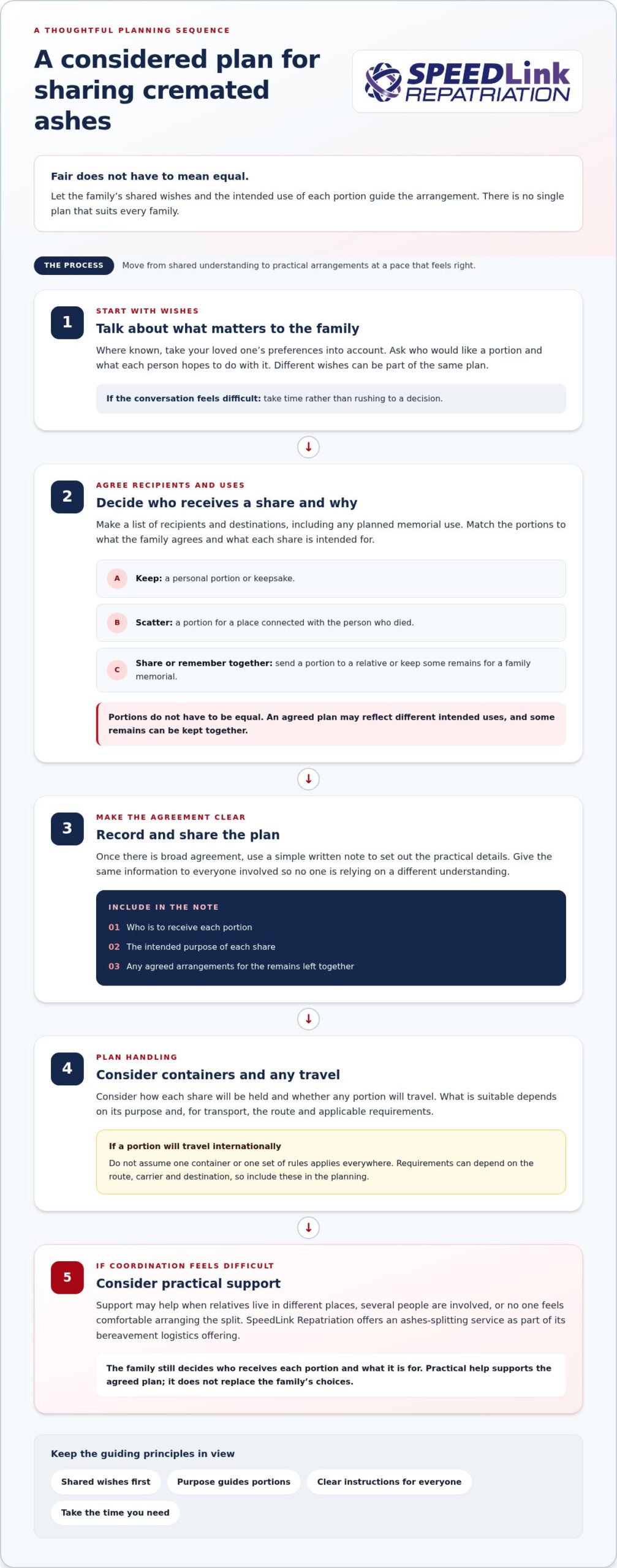
Before making practical arrangements, discuss who would like a portion and what they hope to do with it. A relative may want a personal keepsake, while another may hope to include some ashes in a family memorial. Understanding these intentions helps everyone consider a plan without assuming equal portions are the only fair option. If the conversation feels difficult, take time rather than rushing to a decision.
Let the family’s shared wishes guide the arrangement, rather than an assumption that every portion must be equal.
Once there is broad agreement, decide how to record and share the plan. A simple written note can set out who is to receive a portion, its intended purpose and any agreed arrangements for the rest. Share the same information with everyone involved so no one is relying on a different understanding. This is a practical first step in deciding how to divide cremated ashes with care and consideration.
Plan an ashes split: recipients, portions and suitable containers
A clear plan turns the family’s agreed wishes into practical arrangements. Decide who is to receive a portion, what each share is for and whether any remains will be kept together. Portions don’t have to be equal: the family can agree an arrangement that reflects intended uses rather than treating an equal division as an automatic rule.
- List recipients and destinations. Note who will receive a share and where it is intended to go, including any planned memorial use.
- Clarify each purpose. A portion to keep, scatter or send to a relative may call for different arrangements.
- Discuss handling and containers. Consider how each share will be held and whether any portion will travel. Suitability depends on its purpose and, for transport, the route and applicable requirements.
For international movement, don’t assume one container or set of rules applies everywhere. Requirements can depend on the route, carrier and destination, so make these part of your planning. Legal information can also be specific to a jurisdiction: Mass.gov’s guidance on cremation and funeral law concerns Massachusetts and shouldn’t be treated as a universal rule or as shipping guidance.
How can you organise the practical details respectfully?
Keep the recipient and destination list with the agreed plan so anyone coordinating the split has clear instructions. Families who would rather not manage the practical coordination alone can use SpeedLink’s ashes-splitting service, part of its bereavement logistics offering.
Families decide who receives each share and why; practical handling arrangements support that agreed plan. SpeedLink provides information about ashes-splitting support for families considering professional help.
When a specialist ashes-splitting service can help
Some families would rather not manage every practical detail themselves, particularly while grieving or coordinating wishes across relatives. Support can be helpful when family members live in different places, several people are involved, or no one feels comfortable taking responsibility for arranging the split. Getting help with the practical arrangements doesn’t take away the family’s role in deciding what feels right.
The family can still agree who should receive a portion and what it is intended for. Specialist assistance can help with the practical side of sharing remains, while relatives make their own choices and take the time they need to reach agreement.
How does SpeedLink support families arranging an ashes split?
SpeedLink offers an ashes-splitting service as part of its bereavement logistics offering. Families considering how to divide cremated ashes can include this service in their plans if they would prefer help with the practical arrangements. It provides specialist support without assuming a particular method or outcome.
Before discussing arrangements, it may help to have the family’s agreed wishes to hand. Note who is to receive a share and whether any portions are intended for a memorial or another purpose. If relatives haven’t reached agreement, it’s reasonable to take time to talk before proceeding. Clear communication helps keep the practical arrangements aligned with the family’s decisions.
Every family’s circumstances are personal. SpeedLink provides information about its ashes-splitting service for families considering support with the arrangements.
Take the next step at your own pace
There’s no need to settle every practical detail in one conversation. Once your family has a shared understanding of what matters, you can decide whether you’d like help putting the arrangements in place. Taking time to make that choice can be part of making a thoughtful decision.
If support would make the process easier, SpeedLink’s ashes-splitting service is part of its bereavement logistics offering. SpeedLink also provides specialist support for cremated-remains transport and related arrangements. Whether you’re still working out how to divide cremated ashes or are ready to discuss practical support, you can take the next step when it feels right for your family.
A thoughtful arrangement doesn’t have to be complicated. With time, clear communication and support where it’s welcome, your family can agree a way forward that feels considerate and true to your wishes.
Frequently Asked Questions
Can I divide cremated ashes at home?
Some families choose to manage the practical task themselves, but you don’t have to. If you’re unsure about handling the remains or would find the experience difficult, specialist support is an option. SpeedLink offers ashes splitting as part of its bereavement logistics services.
How should a family decide who receives cremated ashes?
Start by considering any wishes your loved one expressed and who is comfortable receiving a share. Asking each relative privately what they would like can help avoid putting anyone on the spot in a group conversation. One family member can gather responses and share them, giving everyone time to reflect before decisions are settled.
Do cremated ashes have to be divided equally?
No. A family can agree portions that reflect their intended use rather than making every share identical. For example, relatives might want different amounts for personal remembrance or a planned memorial. Before settling the split, consider whether any agreed purpose needs to be accounted for, and keep the arrangement open for discussion if someone has concerns.
Can divided ashes be transported internationally?
Yes, divided ashes can be transported internationally, but requirements vary by destination and route. Include the relevant destination and transport requirements in your plans; don’t assume that rules for one route apply elsewhere. SpeedLink provides specialist cremated-remains transport and customs support to help families arrange international movement.

Article by
David McMillen
I started my career in logistics over 30 years ago which has spanned 2 continents and several different types of courier and logistics operations. I lost my dear Mum back in 2016 and it was in the aftermath of her passing that SpeedLink Repatriation was born. We have endeavoured to bring the same care and attention to all of our clients as my mum received and to date we have helped repatriate hundreds of individuals across the globe.
Disclaimer
International requirements for cremated remains vary by origin, destination, carrier and method of transport and may change without notice.
Content is provided as general guidance and should not be treated as legal advice.
Where necessary, current requirements should be confirmed with the relevant government authority, customs authority, embassy, consulate, postal operator, airline or carrier.
SpeedLink can advise on the requirements applicable to a specific shipment.